How Many Faults to Fail the Irish Driving Test?

Complete guide to understanding fault limits, pass/fail criteria, and what you need to know to succeed in your Irish driving test.

December 7, 2025
11 min read
Driving Test Expert
Irish driving test fault limits and pass criteria

Quick Answer: Fault Limits for Irish Driving Test

Pass/Fail Criteria

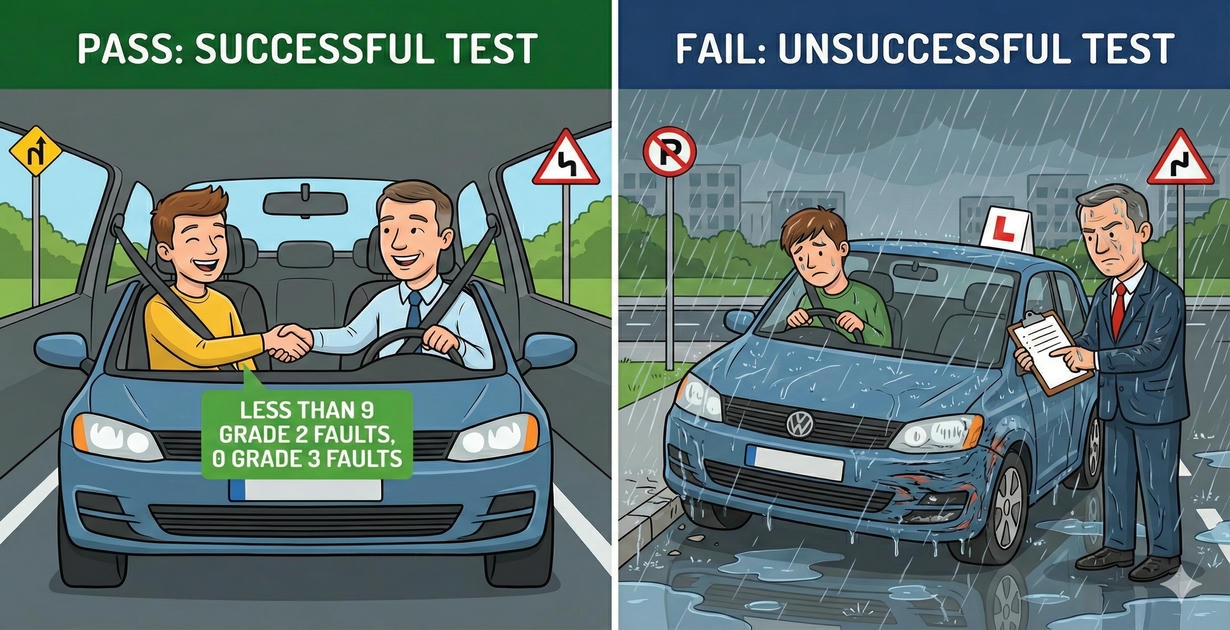
  • To Pass: No Grade 3 faults, maximum 8 Grade 2 faults (no single fault repeated 4+ times)
  • Automatic Fail: Any single Grade 3 fault
  • Automatic Fail: More than 8 Grade 2 faults in total
  • Automatic Fail: Same Grade 2 fault repeated 4 or more times

Understanding the Three-Tier Fault System

The Irish driving test uses a sophisticated grading system to assess your driving competence. Every action during your test is evaluated, and mistakes are categorized into three grades based on their severity and potential danger.

Complete Breakdown of Fault Grades

Grade 1: Minor Faults

Very minor errors that typically don't affect your overall test result. These are small imperfections in execution that don't compromise safety.

Impact on Test: No specific limit. While they're recorded, Grade 1 faults alone won't cause you to fail.

Important: Too many Grade 1 faults in a single category may indicate a pattern and could be escalated.

Common Examples:

  • • Slight hesitation when moving off
  • • Minor positioning errors on straight roads
  • • Slightly uneven steering
  • • Minimal misuse of primary controls (clutch, accelerator)
  • • Minor gear selection timing issues

Grade 2: Lack of Control/Understanding

Errors that aren't immediately dangerous but demonstrate incomplete understanding or control. These faults could become dangerous in different circumstances.

Fault Limit: Maximum 8 faults

Pattern Rule: Repeating the same Grade 2 fault 4 times = automatic fail

Common Examples:

  • • Incorrect or late use of mirrors
  • • Not signaling or signaling late
  • • Minor positioning errors at junctions
  • • Inappropriate speed (too fast or too slow)
  • • Inadequate observation before maneuvers
  • • Poor lane discipline
  • • Incorrect response to road markings
  • • Harsh braking or acceleration

Grade 3: Serious or Dangerous Faults

Serious or dangerous mistakes that pose immediate risk to the driver, examiner, passengers, other road users, or pedestrians.

Fault Limit: 0 faults (Zero tolerance)

Impact: A single Grade 3 fault results in immediate test failure, though the test continues to completion.

Common Examples:

  • • Failing to yield right of way causing danger
  • • Running a red light or stop sign
  • • Dangerous overtaking maneuvers
  • • Causing another vehicle to brake or swerve
  • • Loss of control of the vehicle
  • • Mounting the curb or hitting obstacles
  • • Endangering pedestrians or cyclists
  • • Excessive speed in dangerous situations

Prepare for Your Driving Test

Master Irish traffic signs and road rules to minimize faults. Our interactive quiz covers all signs and scenarios you'll encounter during your test.

Detailed Fault Scenarios and Examples

Understanding exactly what constitutes each type of fault helps you avoid them during your test. Here are real-world scenarios:

Scenario 1: Mirror Use

Grade 1: Checked mirrors but timing was slightly imperfect

Grade 2: Forgot to check mirrors before changing lanes

Grade 3: Changed lanes without checking, causing another car to brake hard

Scenario 2: Speed Control

Grade 1: Speed fluctuated slightly (45-50 km/h in 50 zone)

Grade 2: Drove at 60 km/h in a 50 km/h residential zone

Grade 3: Drove at 70 km/h past a school at drop-off time

Scenario 3: Junction Approach

Grade 1: Approached junction slightly faster than ideal but adjusted smoothly

Grade 2: Didn't observe left sufficiently before emerging

Grade 3: Pulled out causing oncoming traffic to brake suddenly

The Pattern Rule: Why Consistency Matters

One of the most important aspects of the Irish driving test is the pattern rule. Even if you stay under 8 Grade 2 faults total, repeating the same mistake 4 times demonstrates a fundamental weakness in that skill area.

Pattern Fail Example

If you fail to check your blind spot before changing lanes 4 times during your test, you'll fail even if these are your only 4 Grade 2 faults. This pattern indicates insufficient observation skills.

Strategy: Focus on consistency in every aspect of driving, not just avoiding total faults.

Study All Traffic Signs

Understanding traffic signs prevents Grade 2 and Grade 3 faults. Browse our complete database of 410+ Irish traffic signs.

Pass Rate Statistics

Understanding the statistics helps put the fault system in perspective and shows you're not alone in facing this challenge.

Irish Driving Test Statistics (2024-2025)

~55%

National Pass Rate

~52%

First-Time Pass Rate

42%

Fail Due to Grade 2 Faults

28%

Fail Due to Grade 3 Fault

Top Reasons for Test Failure

Based on official data and examiner feedback, here are the most common reasons candidates fail their driving test:

1

Inadequate Observation (Grade 2/3)

Not checking properly at junctions, before changing lanes, or when emerging from side roads

2

Failure to Yield Right of Way (Grade 3)

Not giving way at roundabouts, junctions, or to pedestrians at crossings

3

Excessive Grade 2 Faults (Pattern)

Accumulating more than 8 Grade 2 faults or repeating the same fault 4 times

4

Speed Management (Grade 2/3)

Driving too fast for conditions, exceeding speed limits, or driving dangerously slowly

5

Roundabout Errors (Grade 2/3)

Wrong lane selection, failure to signal, or dangerous entry/exit

Strategies to Minimize Faults

Success in your driving test comes from consistent practice and developing good habits across all areas:

1

Master the Mirror-Signal-Maneuver Routine

Make this sequence automatic for every action. Examiners want to see deliberate, obvious checks.

2

Practice in Test Area

Familiarize yourself with roads, junctions, and roundabouts commonly used in your test centre's routes.

3

Focus on Weak Areas

Identify your weakest skills and practice them extensively to avoid pattern failures.

4

Take Professional Lessons

Approved Driving Instructors know exactly what examiners look for and can correct bad habits early.

5

Study Traffic Signs Thoroughly

Knowing all signs prevents mistakes at junctions, speed limits, and road markings.

6

Mock Tests Before Test Day

Have your instructor conduct mock tests using the official grading system to identify issues.

Ready to Pass Your Driving Test?

Use our comprehensive resources to prepare thoroughly and minimize faults. Master signs, practice scenarios, and test your knowledge.

Frequently Asked Questions

Can I pass if I get 8 Grade 2 faults and several Grade 1 faults?

Yes, you can pass with 8 Grade 2 faults and any number of Grade 1 faults, provided you don't repeat the same Grade 2 fault 4 times and you commit no Grade 3 faults.

Will the examiner stop the test if I make a Grade 3 fault?

No, the test continues to completion even after a Grade 3 fault. The examiner will not tell you during the test that you've failed. You'll receive your result at the end.

How do I know if my fault was Grade 2 or Grade 3?

The key difference is immediate danger. If your action caused another road user to take evasive action (brake, swerve) or posed immediate risk, it's Grade 3. If it showed poor control but didn't create immediate danger, it's Grade 2.

Can examiner discretion affect fault grading?

Examiners follow strict guidelines, but context matters. The same action in different situations might be graded differently. For example, failing to check mirrors on a quiet road vs. a busy motorway.

What happens after I fail my test?

You'll receive a detailed report showing all faults. You can rebook another test (minimum 10 days wait). Use the report to focus your practice on weak areas with your instructor.

Conclusion

Understanding the fault system is crucial for passing your Irish driving test. Remember the key numbers: zero tolerance for Grade 3 faults, maximum 8 Grade 2 faults (with no single fault repeated 4 times), and Grade 1 faults that won't fail you alone.

Success comes from consistent, safe driving across all aspects of the test. Focus on developing good habits, thorough observation, smooth vehicle control, and complete understanding of road rules and traffic signs. With proper preparation and practice, you can minimize faults and pass with confidence.

Most importantly, remember that the driving test assesses your ability to drive safely and confidently. The fault system exists to ensure only competent drivers receive their licence. Use it as a framework for self-improvement, not just a hurdle to overcome.