10 Most Confusing Irish Traffic Signs & What They Mean
Traffic Safety Team
Featured Article
More than half of all learner drivers in Ireland fail their Driver Theory Test on the first attempt — a pass rate sitting around 47% in 2026, according to practice platform data. Road signs and markings consistently rank among the top fail categories, not because the signs are obscure, but because the rules behind them are genuinely counter-intuitive until someone explains them clearly.
Whether you're preparing for your theory test, heading into your practical exam, or simply trying to drive confidently on Irish roads, the ten signs below are the ones most likely to cause hesitation. We've covered each one with its full legal meaning, where you'll find it, what happens if you get it wrong, and exactly what your examiner expects from you.
Key Takeaways
- ✓ Ireland's theory test has a ~53% failure rate; road sign questions are a leading cause (practice platform data, 2026)
- ✓ Regulatory signs (red circles) are prohibitions — violating one during your practical test is an automatic Grade 3 fail
- ✓ The Rural Speed Limit sign doesn't post a speed — it ends the previous zone; your correct speed depends on road classification
- ✓ Motorway barrier boards count down in bars (3, 4, 5): more bars means less merging room — start merging at the 3-bar, not the 5-bar
- ✓ Red triangles = warnings, red circles = prohibitions, blue rectangles = information. Shape first, symbol second
How to Read Any Irish Road Sign in 3 Seconds
Before memorising individual signs, learn the shape-and-colour system. It lets you classify a sign's urgency before you've processed the symbol — which is exactly how experienced drivers read unfamiliar signs at speed.
Red Triangle
Warning — hazard ahead, proceed with caution
Red Circle
Prohibition — you must not do something
Blue Rectangle
Information / direction / permitted action
Yellow Diamond
Temporary — roadworks or incident signage
Use the search and category filters below to jump to a specific sign, or work through all ten from the top. Each card has four tabs — Meaning, Where Found, Rules & Fines, and Exam Info — covering everything you need to know for both the theory test and your practical driving exam.
Which Theory Test Topics Cause the Most Fails?
Relative difficulty ranking based on practice platform error rates, 2026
Clearway
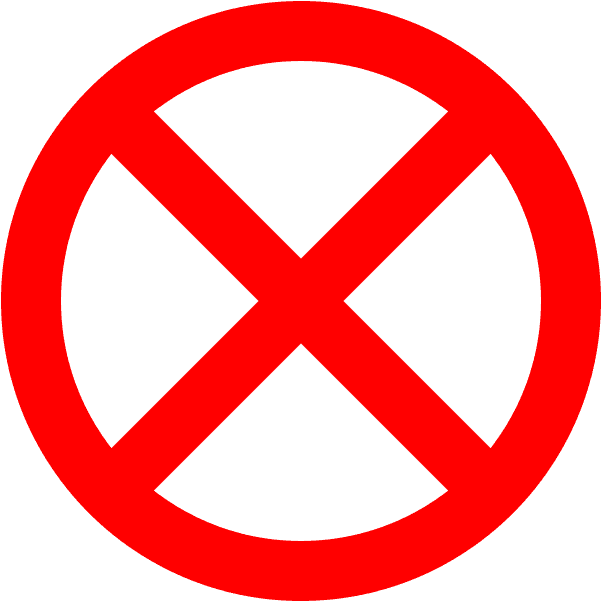
No stopping or parking during stated times to keep the route clear.
- ✓🚫 No stopping or parking on the main carriageway.
- ✓⏰ This restriction usually applies 24/7 (or during peak hours shown on supplementary plates).
What to remember: The Clearway sign catches many learners off guard because it looks similar to a standard parking zone but works very differently. There's no grace period, no loading exception, and no short-stop allowance. During theory test preparation, focus on the critical rule: even stopping to drop a passenger off is a violation. On your driving test, your examiner watches specifically for this kind of roadside hesitation. Get it wrong and you're looking at an instant Grade 3 failure — no second chances.
No Entry
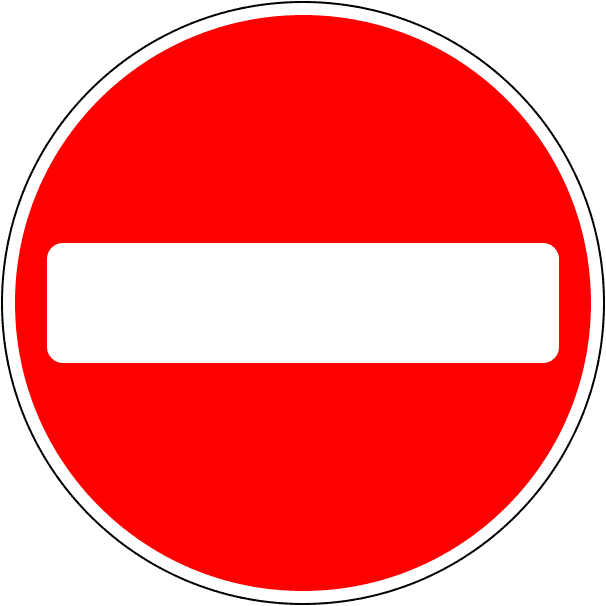
All vehicular entry prohibited from this direction.
- ✓⛔ Do not enter.
- ✓🚫 Vehicular traffic is prohibited from entering this road.
- ✓➡️ This is often used to indicate a one-way street or an exit-only ramp.
What to remember: The No Entry sign is perhaps the most unambiguous sign on Irish roads — yet GPS devices and divided attention continue to cause violations. In city centers, one-way systems change layout at roundabouts and during road works, meaning even experienced drivers can approach an unexpected No Entry. The theory test specifically frames questions around the difference between a No Entry sign and a Do Not Pass sign, two signs that learners consistently confuse. Know both, and you're ahead of a significant portion of test candidates.
No Straight Ahead
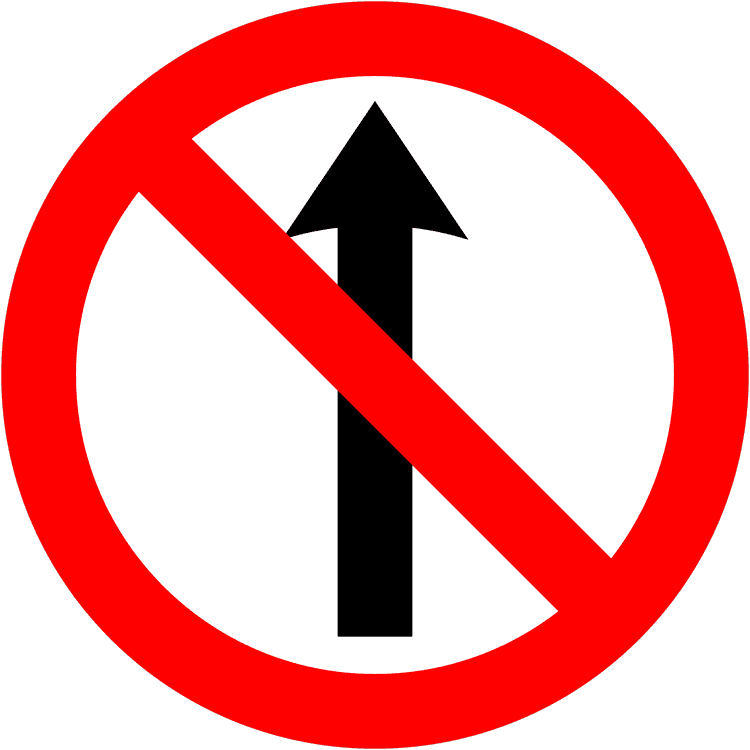
Straight-ahead vehicular movement prohibited.
- ✓🔀 Prohibits going straight. You must turn left or right.
- ✓🚫 Do not continue straight through the junction.
What to remember: This sign trips up learners specifically because it requires forward planning. You can't hesitate mid-junction and then veer left. Your examiner expects you to read the sign early, signal the turn correctly, and execute it cleanly. In practice, the No Straight Ahead appears most often on bus corridors, so if you see a bus lane running straight, take that as a mental cue that cars almost certainly can't follow it. Build this association into your test preparation and junction scanning routine.
No Overtaking
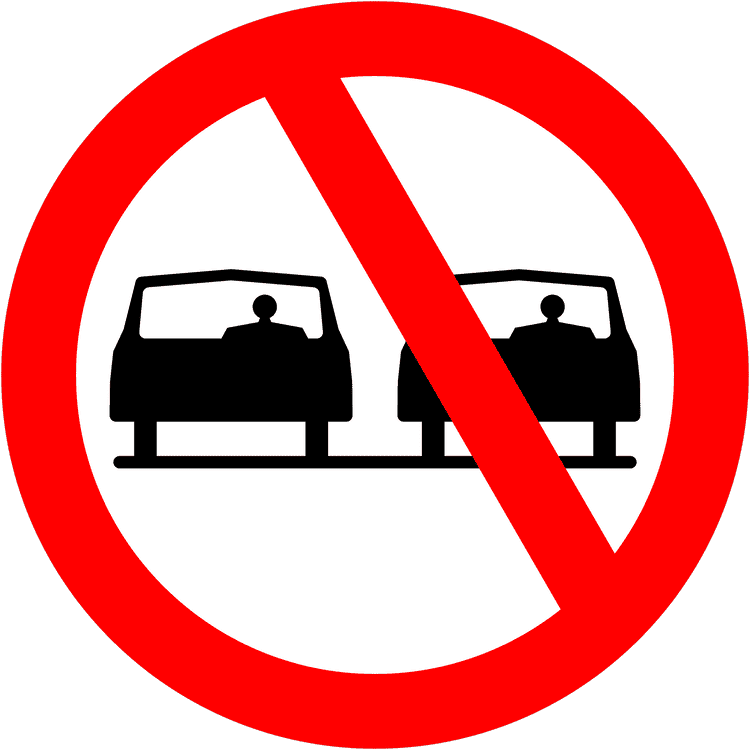
Overtaking manoeuvres prohibited in this stretch.
- ✓⛔ Overtaking other vehicles is prohibited.
- ✓🚗 Do not cross the solid white line if present.
- ✓🔚 This restriction applies until you see the 'End of No Overtaking' sign.
What to remember: Patience is the key skill tested by this sign. Many test candidates understand the rule intellectually but still show impatience behind slow-moving agricultural vehicles on rural roads — which examiners score as poor observation and attitude. It helps to remember that No Overtaking zones exist for documented safety reasons: the RSA places them specifically at locations with elevated collision history. Respecting the zone isn't just about passing your test; it's about surviving the stretch of road ahead.
Rural Speed Limit
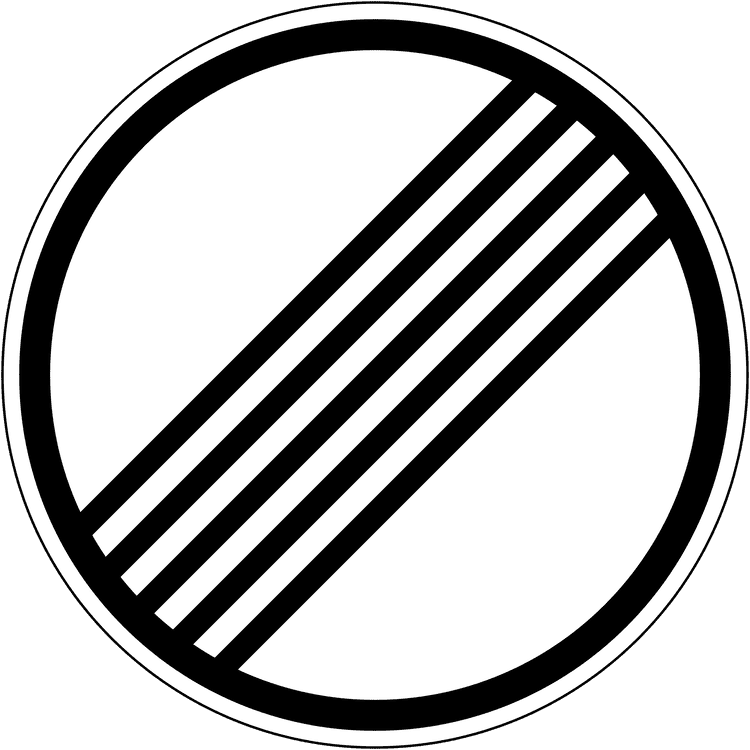
Posted maximum rural road speed.
- ✓🔚 The previous speed limit has ended.
- ✓🚗 The national speed limit for this type of road now applies.
- ✓ℹ️ For cars, this is typically 80 km/h on rural roads.
What to remember: This sign is widely misunderstood because it looks like it's telling you a specific speed, but it isn't. It's terminating the previous zone's limit, not posting a new one. Your correct response depends on your road classification knowledge: single rural carriageway (80 km/h for cars), dual carriageway (100 km/h), motorway (120 km/h), and local rural road (60 km/h). Theory test questions on this sign regularly appear in the top ten most-failed question categories, according to practice platform data. Nail the road-type distinction and you'll answer these correctly every time.
Yield
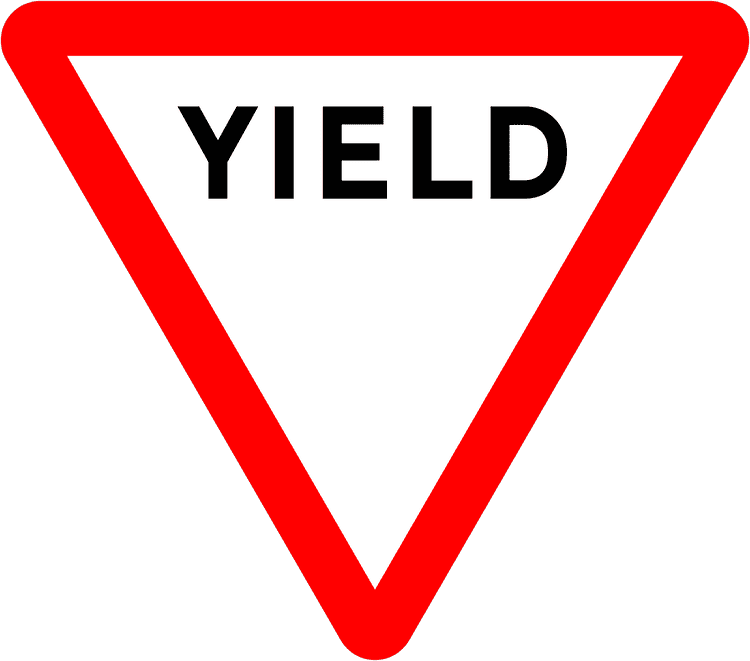
Give way to traffic on the priority road.
- ✓🔽 You must give way to traffic on the major road ahead.
- ✓🚗 Let crossing traffic pass before you proceed.
- ✓🛑 Be prepared to stop if necessary.
What to remember: The Yield sign is where many driving test candidates lose marks on gap judgement. The rule isn't just to slow down — it's to demonstrate that you've assessed the gap correctly, that you're confident the junction is clear, and that you can proceed smoothly without hesitation. Creeping out slowly then accelerating jerkily is a common fail point. Practise approach speed reduction and active left-right scanning on every junction during your lessons, not just on test day. That habit is what examiners reward.
Mini Roundabout Ahead
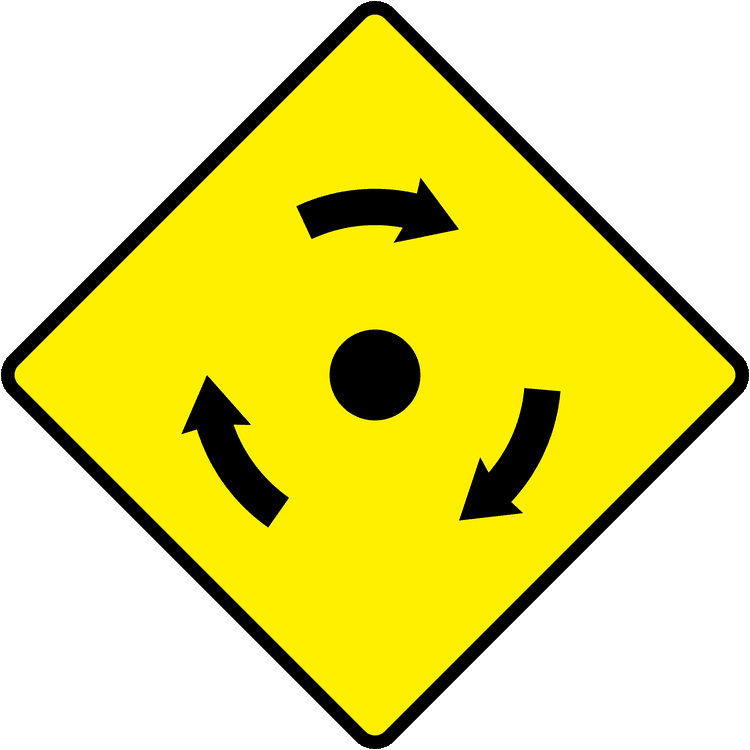
Small roundabout—tight geometry; right-hand priority applies.
- ✓🔄 Warns of a mini-roundabout ahead.
- ✓➡️ Give way to traffic already on the roundabout (from your right).
- ✓🐢 Slow down due to the tight turning circle.
What to remember: Mini roundabouts are a point of genuine confusion because they look like painted road markings rather than real traffic control infrastructure. You're legally required to treat a painted circle exactly like a raised island — drive around it, not over it (unless your vehicle physically can't turn). The theory test exploits this by asking whether mini roundabouts follow the same priority rules as standard ones. They do. Traffic from your right has priority. Always. Getting this right in the test, and in real driving, keeps you safe on residential roads where pedestrians and cyclists share the space.
Shared Space
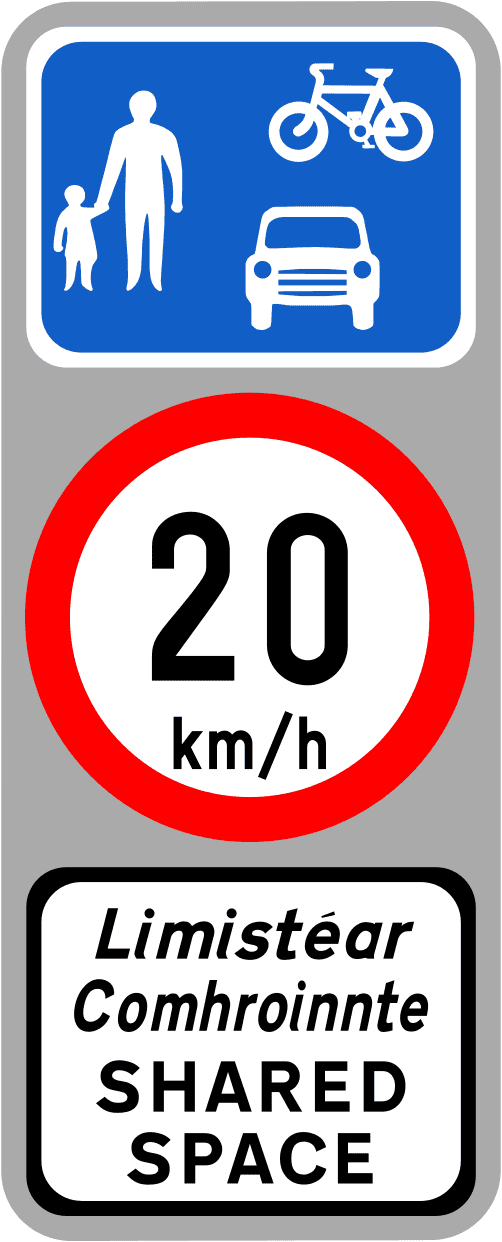
Mixed-priority environment shared by users.
- ✓🤝 You are entering a shared space zone.
- ✓🚶 This area is designed for use by both pedestrians and vehicles.
- ✓🐢 Drive very slowly and be prepared to stop at any time.
What to remember: Shared Space zones are relatively new to the Irish road network, which is why many experienced drivers as well as learners aren't confident about what the sign means. The key distinction from a standard pedestrian crossing is that there's no defined crossing point. Pedestrians can step into the road anywhere. Your responsibility as a driver is to anticipate this at all times and never assume that the absence of a crossing marking means you have right of way. In school zones, this sign carries particular weight: any endangerment of a child carries the most serious penalties available.
Crossroads (Major Road) Ahead
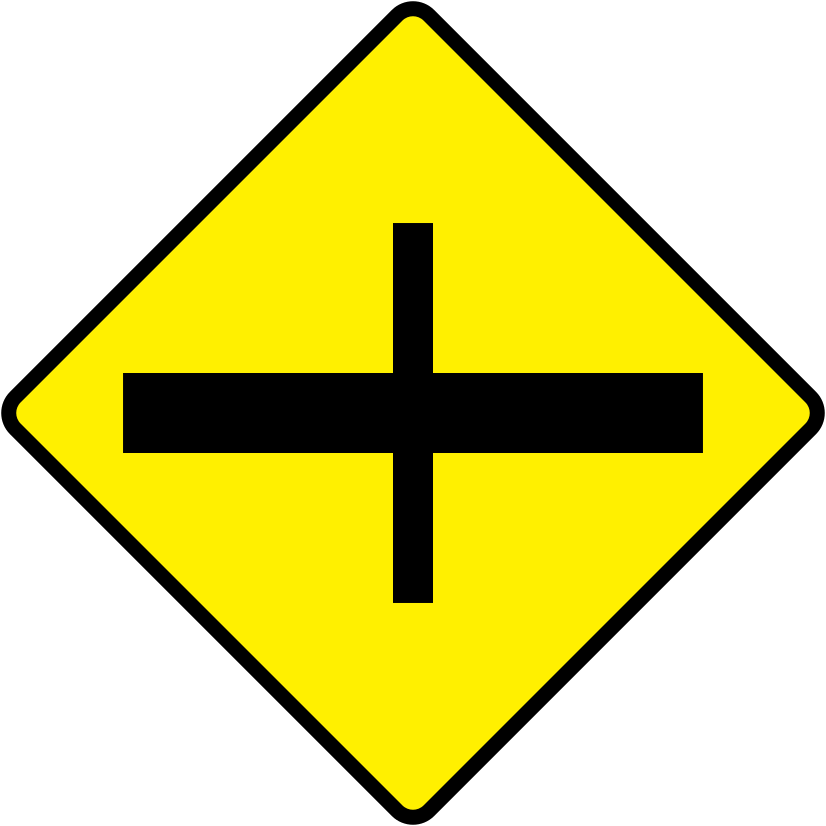
Crossroads with a major road—higher traffic priority crossing.
- ✓➕ Indicates an upcoming intersection with a major road.
- ✓🚗 Traffic on the intersecting road has priority.
- ✓🛑 Be prepared to stop or yield.
What to remember: Rural crossroads junctions are among the most dangerous road locations in Ireland. The RSA consistently identifies rural junction collisions as a major factor in fatality statistics. When you see this sign, your mindset needs to shift from "I'll look and probably go" to "I'll stop if there's any doubt." On National roads with 100 km/h traffic approaching, a vehicle covers 28 metres per second — gaps close faster than learner drivers typically expect. Treat the sign as a prompt to look twice, slow significantly, and emerge only when you're absolutely certain the junction is clear in both directions.
Motorway Taper Barrier Boards
 3 Bars
 4 Bars
 5 Bars
Start, middle, and end of a roadworks lane closure.
- ✓🔻 3 Bars: Lane taper start. Lane begins narrowing; slow down and prepare to merge safely.
- ✓⚠️ 4 Bars: Mid-taper. Merging distance is reduced; merge decisively and check mirrors/blind spots.
- ✓🔚 5 Bars: Taper end. The lane ends immediately; complete your merge now or prepare to stop.
What to remember: Barrier boards are among the top theory test fail signs, specifically because the 3-bar, 4-bar, and 5-bar boards are visually similar and candidates confuse them under exam pressure. The memory shortcut is simple: more bars means less room. When you see a 3-bar board, start checking your mirrors and positioning. By the 4-bar board, you should be signalling. At the 5-bar board, you must already be merged. Waiting until the last board to start reacting is the mistake. Build your merge plan from the first warning sign you spot — the same way motorway professionals drive every day.
Interactive Theory Test Quiz
Test your driving sign knowledge on these confusing signs.
Question 1: When you see the Rural Speed Limit sign (white circular sign with diagonal black stripes/border), what does it mean?
Question 2: What does a Clearway sign prohibit during its operational hours?
Question 3: What is the correct reaction when you see a 4-Bar Motorway Taper Barrier Board?
Frequently Asked Questions
What is the most confusing Irish traffic sign for theory test candidates?
The Rural Speed Limit sign is consistently one of the most misunderstood signs because it doesn't specify a speed — it ends the previous restricted zone. Candidates must know the road classification to determine the correct national speed limit, whether 60, 80, 100, or 120 km/h.
Do Irish traffic signs follow the same rules as UK road signs?
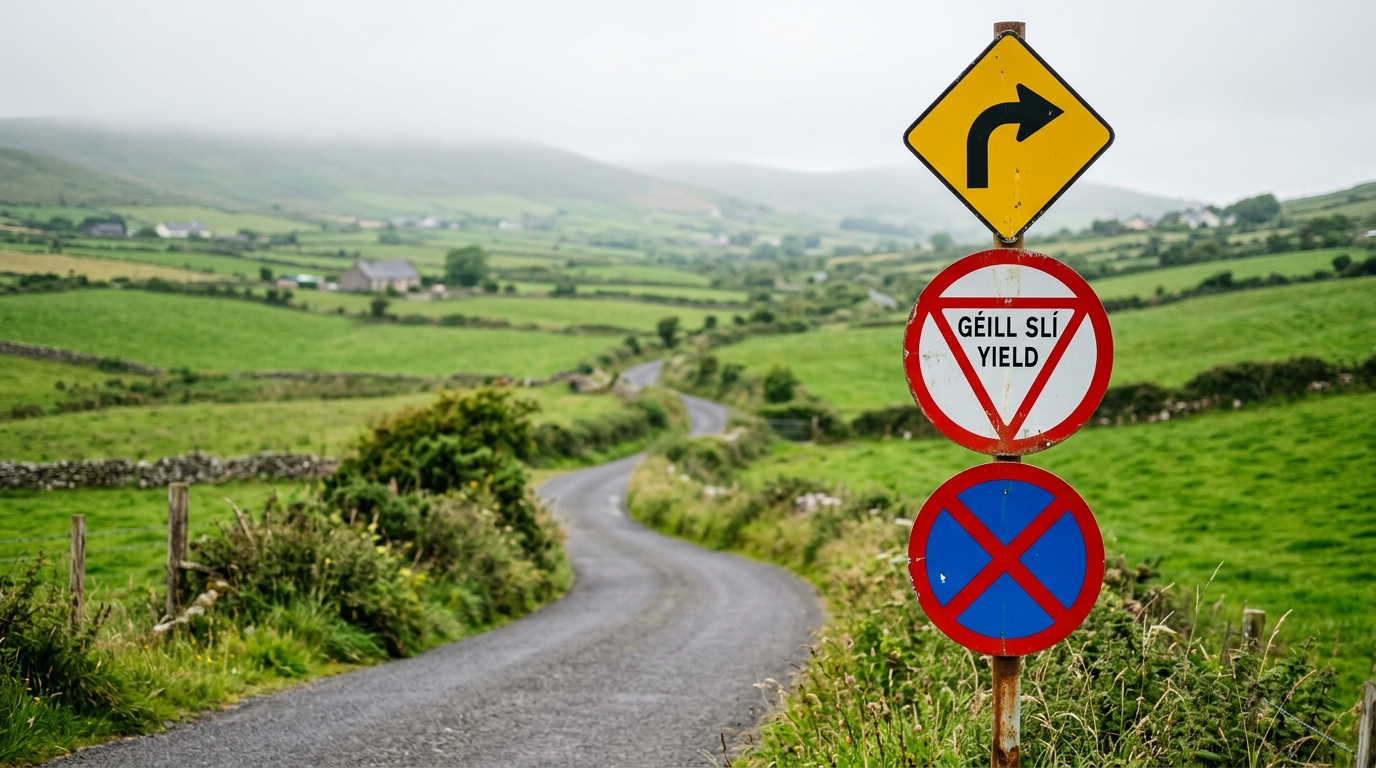
Not entirely. While Ireland and the UK share some sign conventions, Ireland has unique signs including the bilingual Yield / Géill Slí sign in Gaeltacht areas, the Rural Speed Limit sign, and a distinct color-coded system: red triangles for warnings, red circles for prohibitions, blue rectangles for directions.
Can I fail my Irish driving test by misreading a road sign?
Yes. Violating a regulatory sign such as No Entry, Clearway, or No Overtaking during your practical test results in an automatic Grade 3 failure. Misreading a sign, even once, is enough to fail the test on the spot regardless of your performance elsewhere.
What is the difference between a Yield sign and a Stop sign in Ireland?
At a Yield sign (including the bilingual Géill Slí version), you must slow and give way but are not required to make a complete stop if the junction is clear. A Stop sign requires a complete stop before proceeding, regardless of visibility or traffic conditions.
How do I identify what category an Irish road sign belongs to?
Shape and color are the fastest identifiers. Red triangles = warning signs (hazard ahead). Red circles = regulatory prohibitions (you must not do something). Blue rectangles = informational and directional signs. Yellow diamonds appear on temporary roadworks signs. This system lets you classify a sign's urgency before you've read its symbol.
Related Articles
Improve Your Driving Knowledge
Download our app to test your understanding of traffic signs, or explore more articles on our blog.