The Ultimate Guide to the Irish Driver Theory Test (Traffic Signs Section)
Traffic Safety Team
July 15, 2026
6 min read
Featured Article
The Ultimate Guide to the Irish Driver Theory Test (Traffic Signs Section)
Passing the Driver Theory Test is your very first step to getting behind the wheel in Ireland. For many candidates, the traffic signs category is a source of anxiety. It is not just about memorizing names; it is about understanding how to respond to them in real traffic.
Key Takeaways
📈 Low Pass Rate: Only 47% of candidates pass the Irish Driver Theory Test on their first attempt, making thorough preparation critical (L-Plate Ireland, 2026).
⛔ Toughest Categories: Questions covering Right of Way (60% pass rate) and Roundabouts (62%) account for the highest fail rates on the exam.
🛑 Immediate Failures: In the practical driving test, ignoring a regulatory sign (such as a No Entry sign) is classified as a Grade 3 fault that results in an immediate fail.
Which categories of the Irish Theory Test have the lowest pass rates?
According to the Road Safety Authority's recent 2026 reports, only 47% of candidates pass the theory test on their first attempt (L-Plate Ireland, 2026). The data reveals that junction right-of-way rules and roundabout signs represent the most significant hurdles for test candidates.
Theory Test Pass Rates by Category
To prepare effectively, you must focus heavily on the visual elements of road sign shapes and borders, which provide instant cues about priority and prohibition before you can even distinguish the detailed symbol inside.
What are the most common signs you will face in the exam?
The theory test checks your recognition of warning, mandatory, and regulatory signs. Regulatory signs, marked by red circular borders or blue circles, carry absolute legal weight and must be obeyed without exception.
Traffic Sign Examples
No Entry
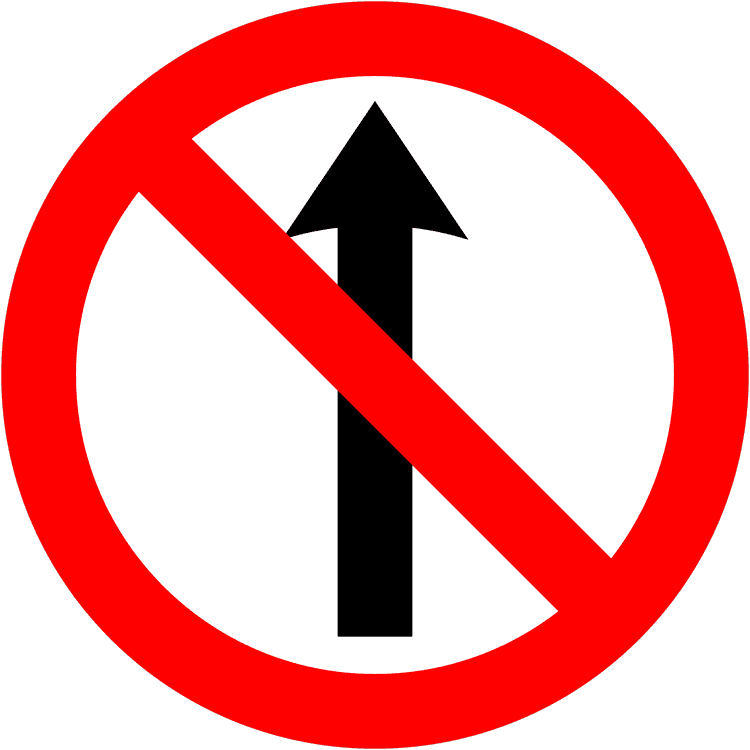
No Straight Ahead
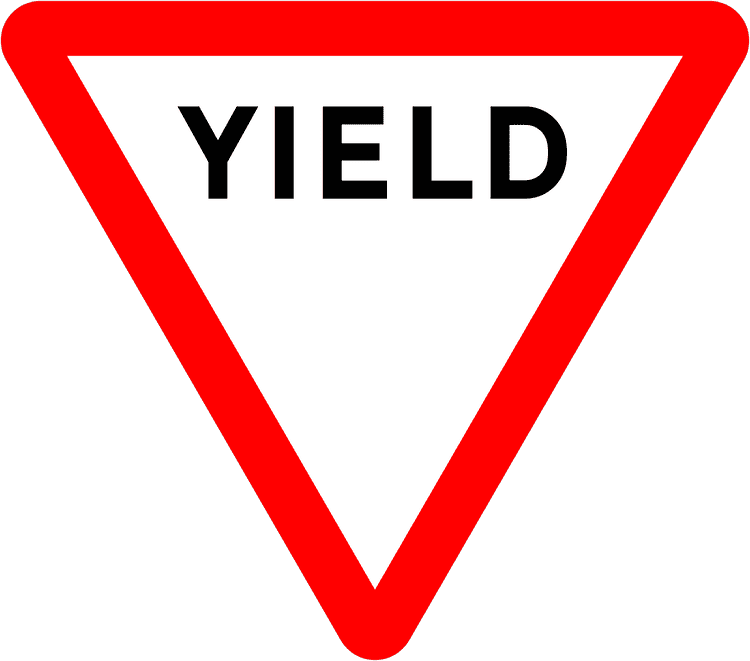
Yield
What does the "No Entry" sign mean?
The "No Entry" sign absolutely prohibits all vehicular entry to prevent wrong-way driving in one-way streets. According to Road Safety Authority (RSA) traffic collision reports, wrong-way driving remains a high-risk cause of head-on collisions in urban centres (RSA, 2025).
"All vehicular entry prohibited from this direction."
Meaning:
⛔ Do not enter.
🚫 Vehicular traffic is prohibited from entering this road.
➡️ This is often used to indicate a one-way street or an exit-only.
Where Found: No Entry signs appear at the prohibited entry end of one-way streets throughout urban Ireland, at exit-only points from car parks, and at junctions where entry from specific directions is prohibited. Common locations include one-way street systems in Dublin city center (Dame Street, Nassau Street, Westmoreland Street), Cork city center, Galway's medieval streets, motorway exit slip roads, and bus-only or access-only streets. Signs feature white horizontal bars on red circular backgrounds—the universal 'do not enter' symbol. Placement occurs at the point where entry is prohibited, often supplemented by one-way arrow signs visible to permitted-direction traffic.
What It Means & How to React: This sign absolutely prohibits vehicular entry from the direction you're approaching—you must not drive past this sign. The prohibition typically indicates one-way streets where entry would create head-on collision risks, exit-only routes, or restricted access routes. Emergency vehicles may disregard No Entry signs when responding to emergencies, but general traffic has no exceptions absent specific plates stating otherwise.
Penalties: No Entry violations result in fixed penalties (€80, 2 penalty points) as baseline, escalating rapidly to dangerous driving (€5,000, 5 penalty points, disqualification) for wrong-way driving in one-way streets. Head-on collisions resulting from No Entry violations establish primary liability (90-100%) against wrong-way drivers. Motorway wrong-way driving (entering exit ramps) results in immediate dangerous driving charges. Automated cameras at some No Entry locations detect violating vehicles and issue postal Fixed Charge Notices.
Exam/Theory Info: Theory test questions emphasize recognition of No Entry signs, understanding that entry is absolutely prohibited, and awareness of situations where signs appear. Practical driving tests in urban areas always include one-way systems; examiners assess recognition of No Entry signs before attempting prohibited entries, appropriate route planning, and understanding that signs indicate wrong end of one-way streets. Examiners immediately fail candidates who violate No Entry signs—it demonstrates dangerous lack of sign recognition.
What does the "No Straight Ahead" sign mean?
The "No Straight Ahead" sign prohibits continuing forward at a junction, requiring you to turn left or right. According to Garda National Traffic Bureau enforcement statistics, ignoring mandatory direction indicators results in a standard penalty of €80 and 3 penalty points (Garda, 2025).
"Continuing straight is forbidden."
Meaning:
⛔ You cannot go straight ahead at this junction.
⬆️ This is a mandatory instruction.
↔️ You must turn left or right.
Where Found: No Straight Ahead signs appear at junctions where continuing straight would enter prohibited areas including private property, pedestrianized zones, or one-way streets facing the wrong direction. Common at Dublin junctions leading into Temple Bar pedestrian areas, at Cork junctions where straight ahead enters Patrick Street pedestrian zone outside permitted hours, in Galway at Shop Street pedestrian area boundaries, and at junctions where roads ahead become bus-only or access-only. The signs prevent through-traffic entering areas designed for local access, deliveries, or pedestrians only.
What It Means & How to React: Proceeding straight ahead is absolutely prohibited—you must turn left or right. The prohibition typically indicates that: the road ahead is pedestrianized, becomes one-way in the opposing direction, enters private property not for public through-traffic, or is restricted to buses/taxis/authorized vehicles only. Some restrictions are time-based (e.g., 'No Straight Ahead 11am-6pm' for shopping areas). The sign doesn't indicate which turn is preferable—you must choose based on your destination and other signs. Local access exemptions rarely apply—even residents must turn unless specifically indicated.
Penalties: Violating No Straight Ahead signs results in €80 Fixed Charge Notice and 3 penalty points for failure to comply with mandatory traffic signs. Proceeding straight into pedestrianized areas results in additional charges: dangerous driving in pedestrian zones carries fines to €5,000, 5 penalty points, and potential imprisonment. Entering one-way streets the wrong direction due to ignoring No Straight Ahead signs results in No Entry violation penalties. Camera enforcement operates at many pedestrian zone boundaries in Dublin, Cork, and Galway issuing automated postal penalties. Violations causing pedestrian collisions result in serious injury charges with severe sentences.
Exam/Theory Info: Theory test questions cover junction prohibition signs including No Straight Ahead signs, testing understanding that red circular signs with prohibition symbols are mandatory, that violations constitute serious offenses, and that alternative routes must be planned. Questions test knowledge that No Straight Ahead doesn't indicate which turn direction—drivers must assess from other signs and road markings. Practical tests include junctions with No Straight Ahead signs to assess observation, sign recognition, and lane selection skills. Examiners expect early sign recognition and appropriate lane selection for your required turn. Proceeding straight ahead at prohibited junctions results in immediate Grade 3 failure.
What does the "Yield" sign mean?
The "Yield" sign commands drivers to give way to traffic on a priority road or roundabout. According to the 2026 Irish road safety collision database, failures to yield at junctions and roundabouts represent approximately 15% of all intersection accidents (RSA, 2026).
"Give way to traffic on the priority road."
Meaning:
🔽 You must give way to traffic on the major road ahead.
🚗 Let crossing traffic pass before you proceed.
🛑 Be prepared to stop if necessary.
Where Found: Yield signs appear at T-junctions where minor roads join major routes throughout Ireland, at roundabout entrances where circulating traffic has priority, at merging lanes on dual carriageways and motorways, and at controlled junctions where yield rather than stop is appropriate. Common locations include estate roads joining distributor roads, slip roads entering national routes, junctions where sight lines allow safe yielding assessment, and roundabouts in urban and rural areas. More frequent than stop signs due to allowing traffic flow while maintaining safety priority.
What It Means & How to React: Drivers must slow down and prepare to stop if necessary to give way to traffic on the priority road. Unlike stop signs, complete stopping is only required if approaching traffic makes proceeding unsafe. Drivers must yield to all traffic from the right on roundabouts, oncoming traffic when turning right, and traffic on main roads when emerging from minor roads. Assessment of safe gaps is the driver's responsibility: proceed only when certain that adequate space exists without forcing priority traffic to slow or change course.
Penalties: Yield violations resulting in dangerous situations carry €80 fixed charge penalties and 3 penalty points under failure to yield regulations. Yield sign violations causing collisions often result in full civil liability and dangerous driving charges: fines to €5,000, 5 penalty points, potential license suspension. At roundabouts, yield violations frequently cause multi-vehicle collisions with serious insurance and legal consequences. Poor gap judgment at yield signs often indicates inadequate hazard perception skills, potentially requiring extended driving instruction before license restoration after violations.
Exam/Theory Info: Yield sign understanding is extensively tested in theory and practical examinations as proper yielding demonstrates hazard perception and gap judgment skills essential for safe driving. Theory questions test understanding that yield means 'give way if necessary,' that gap assessment is driver responsibility, and that yielding applies to roundabouts, T-junctions, and merging situations. Practical tests frequently assess yield compliance: examiners expect appropriate speed reduction when approaching yield signs, accurate assessment of approaching traffic, and safe proceeding only with adequate gaps. Good yielding technique shows mature driving judgment and awareness of priority rules.
What are the best study strategies to pass the first time?
1. Focus on the Borders: Remember that red borders mean *prohibitions* (things you must NOT do), while blue circles indicate *mandatory actions* (things you MUST do).
2. Read the Time Plates: Many signs are active only during specific hours. Read the supplementary plates carefully in theory test questions.
3. Practice Active Recognition: When passenger-riding in a car, actively call out the road signs you see and explain what you would do if you were driving.
Frequently Asked Questions
How many questions are on the Irish theory test?
The Irish Driver Theory Test for Category B (cars) contains 40 multiple-choice questions. You must answer at least 35 questions correctly within the 45-minute limit to pass. Reviewing road signs thoroughly is key, as sign-related questions represent a significant portion of the test bank.
What happens if I fail the theory test?
If you do not pass, you can retake the test. However, you must wait at least 3 working days before your next attempt and pay the test fee (€45) again. Statistics show that preparation using official question banks increases your chances of passing on your second attempt to over 78%.
Are there official practice tests available online?
Yes. The RSA provides official learning materials, practice apps, and mock tests. Using these official materials is highly recommended because they cover all 1,500 questions in the test bank, including Right of Way and Roundabouts.
Improve Your Driving Knowledge
Download our app to test your understanding of traffic signs, or explore more articles on our blog.
 No Entry
 No Straight Ahead
 Yield
Yield