Back to All Articles
Traffic Signs

The Complete Irish Traffic Sign Shapes & Colors Cheat Sheet

Traffic Safety Team

September 16, 2026
6 min read
The Complete Irish Traffic Sign Shapes & Colors Cheat Sheet

Featured Article

Memorizing hundreds of individual traffic signs can feel overwhelming when preparing for your Driver Theory Test. Fortunately, the Irish road sign system is designed with a logical visual code.

By understanding the meanings behind the shapes and colors of the signs, you can determine their general message from a distance before you can even see the icon inside.

Key Takeaways

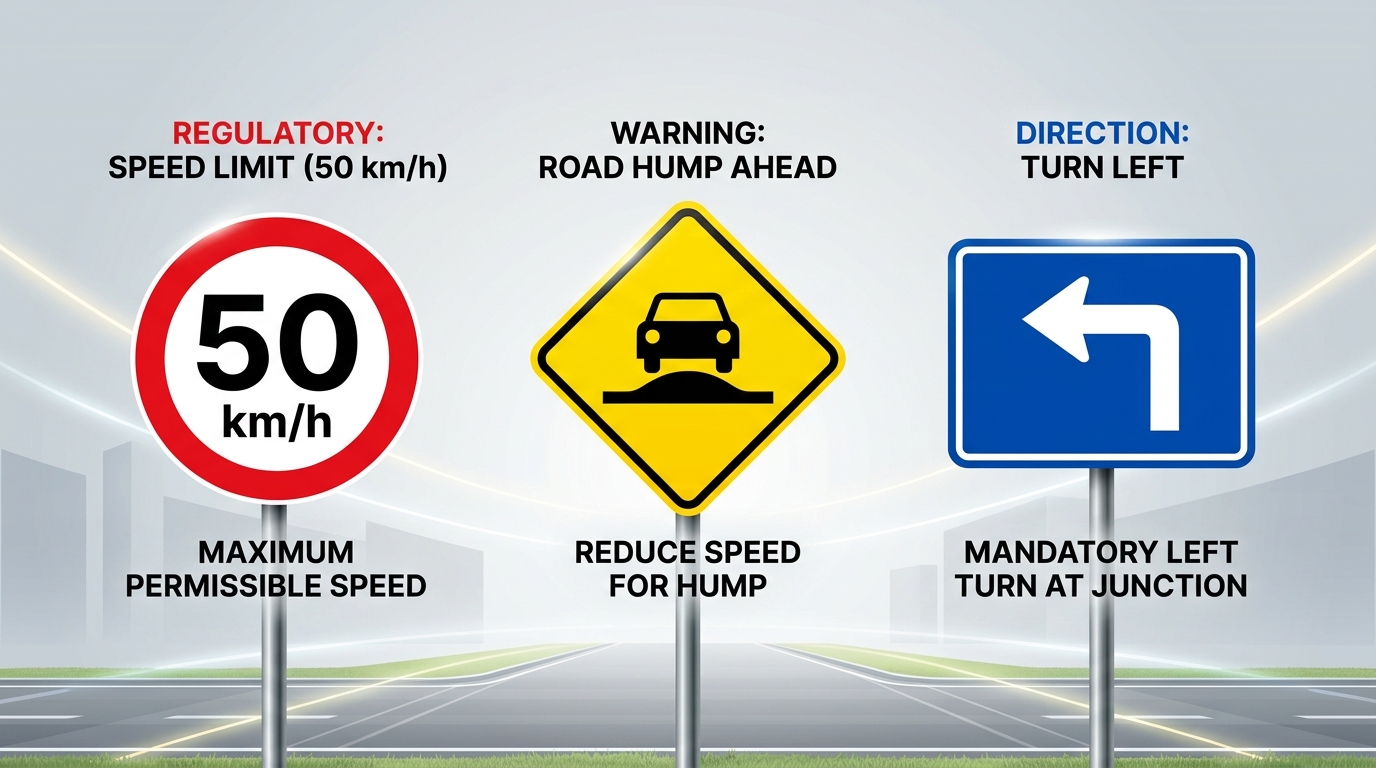
  • 🔴 Regulatory circles: Circles with red borders command absolute prohibitions, such as speed limits.
  • 🟡 Warning diamonds: Yellow diamonds indicate upcoming hazards, unique in Europe to Irish roads.
  • 🔵 Mandatory blue: Solid blue circles indicate actions you must take, like roundabouts or exits.

Here are examples representing the three main categories of traffic signs in Ireland:

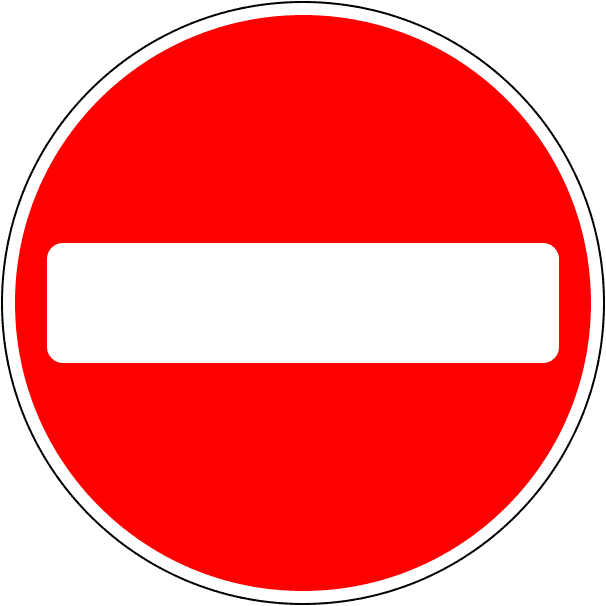
What does the "No Entry" sign tell us about road directions?

"All vehicular entry prohibited from this direction."

  • Meaning:
  • ⛔ Do not enter.
  • 🚫 Vehicular traffic is prohibited from entering this road.
  • Traffic Sign Examples

    No EntryNo Entry
    Crossroads Major Road AheadCrossroads Major Road Ahead
    Shared SpaceShared Space
  • ➡️ This is often used to indicate a one-way street or an exit-only.
  • Where Found: No Entry signs appear at the prohibited entry end of one-way streets throughout urban Ireland, at exit-only points from car parks, and at junctions where entry from specific directions is prohibited. Common locations include one-way street systems in Dublin city center (Dame Street, Nassau Street, Westmoreland Street), Cork city center, Galway's medieval streets, motorway exit slip roads, and bus-only or access-only streets. Signs feature white horizontal bars on red circular backgrounds—the universal 'do not enter' symbol. Placement occurs at the point where entry is prohibited, often supplemented by one-way arrow signs visible to permitted-direction traffic.
  • What It Means & How to React: This sign absolutely prohibits vehicular entry from the direction you're approaching—you must not drive past this sign. The prohibition typically indicates one-way streets where entry would create head-on collision risks, exit-only routes, or restricted access routes. Emergency vehicles may disregard No Entry signs when responding to emergencies, but general traffic has no exceptions absent specific plates stating otherwise.
  • Penalties: No Entry violations result in fixed penalties (€80, 2 penalty points) as baseline, escalating rapidly to dangerous driving (€5,000, 5 penalty points, disqualification) for wrong-way driving in one-way streets. Head-on collisions resulting from No Entry violations establish primary liability (90-100%) against wrong-way drivers. Motorway wrong-way driving (entering exit ramps) results in immediate dangerous driving charges. Automated cameras at some No Entry locations detect violating vehicles and issue postal Fixed Charge Notices.
  • Exam/Theory Info: Theory test questions emphasize recognition of No Entry signs, understanding that entry is absolutely prohibited, and awareness of situations where signs appear. Practical driving tests in urban areas always include one-way systems; examiners assess recognition of No Entry signs before attempting prohibited entries, appropriate route planning, and understanding that signs indicate wrong end of one-way streets. Examiners immediately fail candidates who violate No Entry signs—it demonstrates dangerous lack of sign recognition.
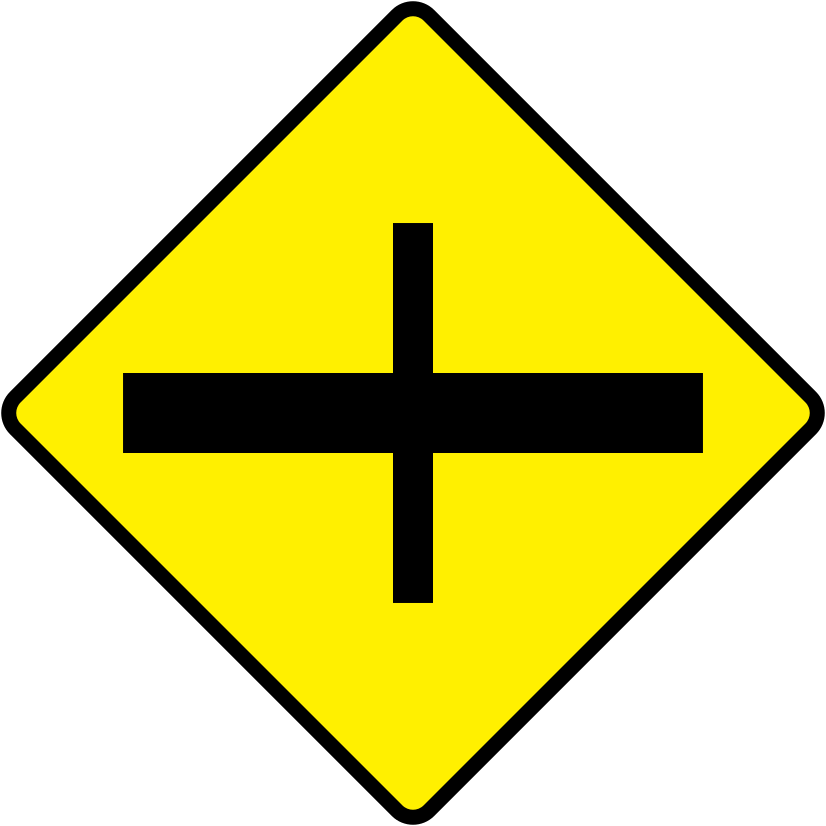
  • What does the Crossroads (Major Road) Ahead sign warn against?

    "Crossroads with a major road—higher traffic priority crossing."

  • Meaning:
  • ➕ Indicates an upcoming intersection with a major road.
  • 🚗 Traffic on the intersecting road may have priority.
  • 🛑 Be prepared to stop or yield.
  • Where Found: This sign appears on minor rural roads as they approach intersections with National Primary and Secondary Routes throughout Ireland. Common locations include approaches to the N17 Galway-Sligo road from local lanes, minor roads meeting the N71 West Cork coastal route, and country roads intersecting busy trunk roads near towns. The sign typically appears 50-100 meters before major road junctions in counties with extensive rural networks such as Roscommon, Leitrim, and Cavan.
  • What It Means & How to React: You must recognize that traffic on the intersecting major road has priority and travels at significantly higher speeds—typically 80-100 km/h. Reduce your speed to 30-40 km/h and prepare to stop completely at the junction. Scan left and right repeatedly as you approach. Gaps that appear adequate may close faster than anticipated due to high approach speeds. Check for motorcycles and cyclists who can be obscured by larger vehicles. Never assume drivers on the major road will slow for you. Only proceed when you have a clear, safe gap in both directions.
  • Penalties: Failure to yield at a major road junction carries 2 penalty points and an €80 Fixed Charge Notice. If you cause a collision by failing to yield, penalties escalate dramatically: careless driving brings 2 penalty points and fines up to €2,000, while dangerous driving results in 5 penalty points, fines up to €5,000, imprisonment up to 6 months, and mandatory disqualification. You will typically be assigned full liability in insurance claims if you fail to yield properly at a major road junction.
  • Exam/Theory Info: Theory test questions extensively cover junction priority rules and the distinction between minor and major roads. You must understand that this sign indicates you are on the minor road and must yield to all traffic. During practical tests, examiners evaluate early speed reduction, effective observation with visible head movements checking both directions multiple times, correct positioning at the junction line, and safe gap selection. Emerging into the path of traffic on the major road, causing them to brake, results in immediate Grade 3 failure.
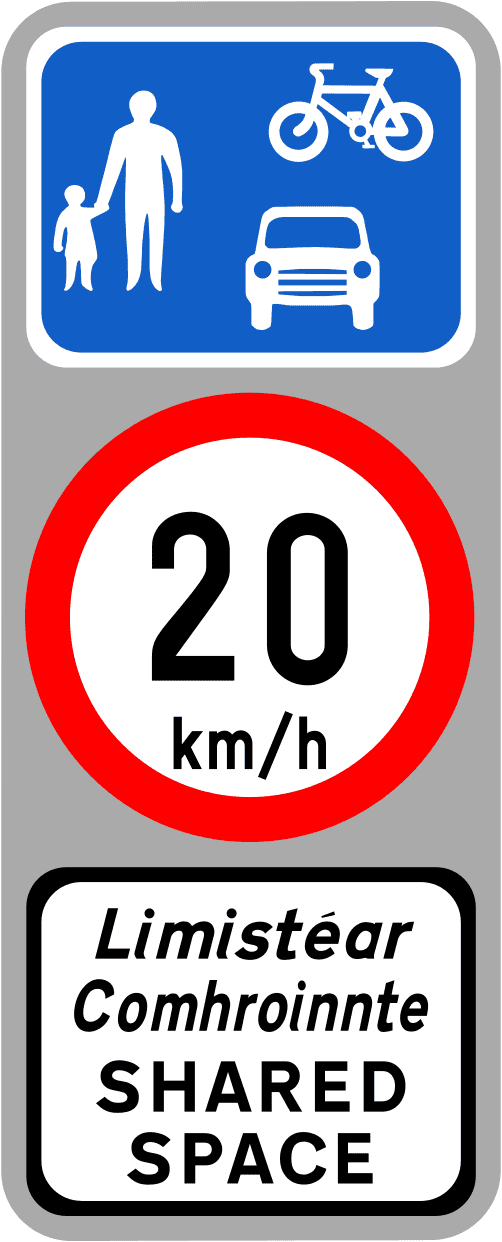
  • What is a Shared Space zone in Irish urban planning?

    "Mixed-priority environment shared by users."

  • Meaning:
  • 🤝 You are entering a shared space zone.
  • 🚶 This area is designed for use by both pedestrians and vehicles.
  • 🐢 Drive very slowly and be prepared to stop at any time.
  • Where Found: Shared space zones implemented throughout Ireland in urban regeneration areas including Dublin city center pedestrian priority zones, Cork Patrick Street area, Galway Shop Street vicinity, town center renewal projects, housing estate community areas, school zone environments, and mixed-use developments where pedestrian and vehicle integration promoted. These innovative traffic management areas reduce traditional traffic segregation while enhancing community interaction and urban livability.
  • What It Means & How to React: Integrated traffic environment where pedestrians, cyclists, and vehicles share the same space without traditional traffic segregation, requiring enhanced mutual awareness and courtesy. Speed limits typically reduced to 10-20 km/h with vehicles giving absolute priority to pedestrians and vulnerable road users. Design philosophy promotes community interaction, reduces traffic dominance, and creates more livable urban environments while maintaining essential vehicle access for residents and services.
  • Penalties: Violations in shared space zones carry enhanced penalties due to pedestrian safety priority: €80-€160 for inappropriate speeds, €160-€2,000 for dangerous driving endangering pedestrians, automatic 5 penalty points for serious violations. Failure to give way to pedestrians results in enhanced penalties and potential dangerous driving charges. Commercial vehicle operators face additional scrutiny and potential access restrictions for violations in shared space environments.
  • Exam/Theory Info: Shared space zone understanding demonstrates advanced traffic awareness and vulnerable road user consideration essential for modern urban driving competency. Theory test questions address shared space protocols, appropriate speeds, and pedestrian priority principles. Understanding shared space concepts indicates readiness for innovative traffic management environments requiring enhanced social awareness and driving courtesy. This knowledge supports community-focused driving attitudes and demonstrates comprehensive understanding of evolving urban mobility solutions essential for contemporary driving citizenship.
  • What are the main categories in the Irish sign shape and color code?

    1. Regulatory Signs (Mandatory Rules):

  • Shape: Circular.
  • Color: Red borders with white backgrounds (Prohibitions, like speed limits) or solid blue backgrounds (Mandatory instructions, like turn left).
  • Rule: You must obey these by law.
  • 2. Warning Signs (Hazards Ahead):

  • Shape: Diamond (or triangular for temporary roadworks).
  • Color: Yellow diamonds with black icons (Warning) or orange rectangles (Temporary roadworks).
  • Rule: Alert you to hazards; reduce speed and prepare to react.
  • 3. Information Signs (Directions & Nav):

  • Shape: Rectangular.
  • Color: Blue (Motorways), Green (National Primary roads), White (Local roads), or Brown (Tourist attractions).
  • Rule: Provide navigational assistance and distance information.
  • Frequently Asked Questions

    What do yellow diamond road signs mean in Ireland?

    Yellow diamond signs are warning signs. They alert you to hazards, sharp turns, or dangerous road layouts ahead, unique in Europe to Irish roads.

    What is the difference between a red circle and a blue circle road sign?

    Red circular signs denote prohibitions (things you must NOT do, like speed limits). Blue circular signs denote mandatory instructions (things you MUST do, like keep left).

    What color are motorway signs in Ireland?

    Motorway directional and information signs in Ireland have a blue background, distinguishing them from green national roads and white local roads.

    Improve Your Driving Knowledge

    Download our app to test your understanding of traffic signs, or explore more articles on our blog.