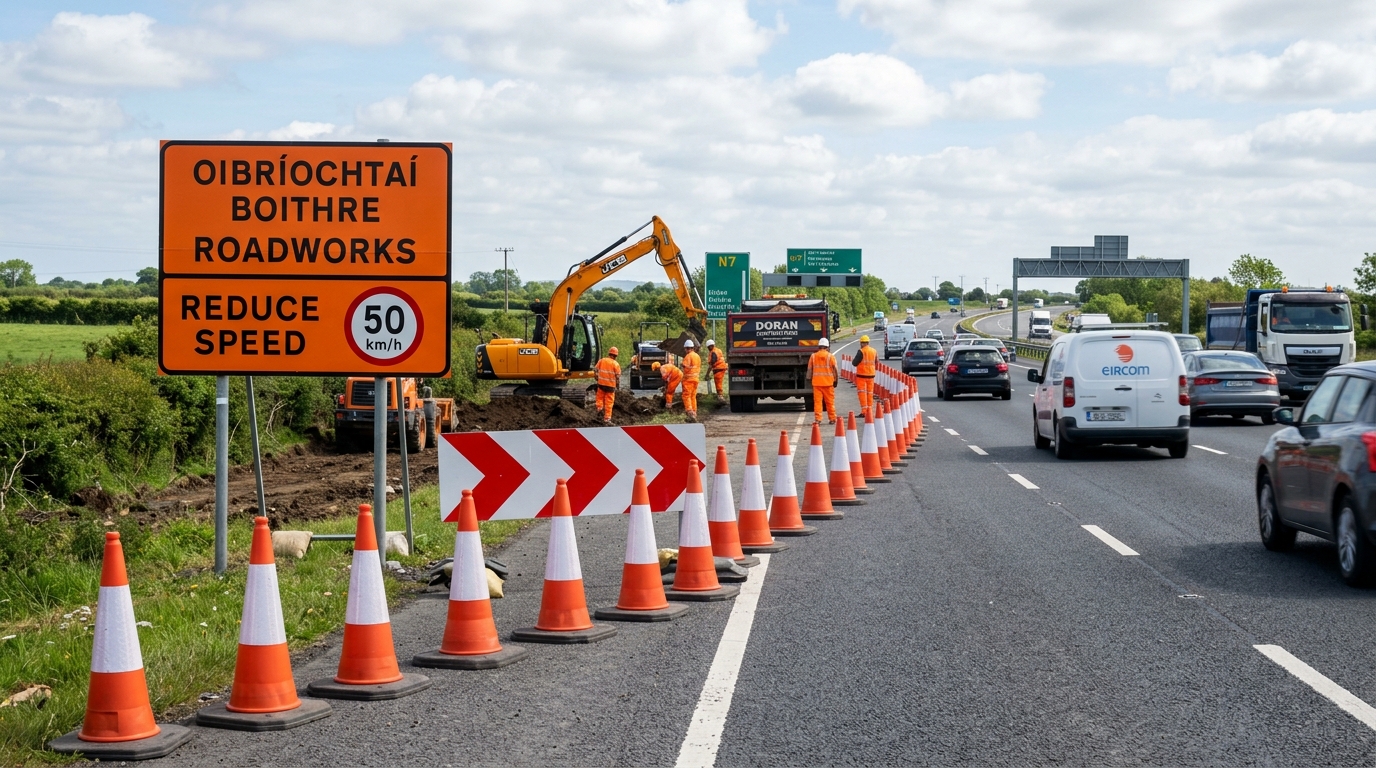
Roadworks are a temporary necessity for maintaining Ireland's infrastructure. However, they introduce unexpected hazards, lane closures, and changing speed limits that frequently trip up learner drivers.
In the practical driving test, examiners pay close attention to how you respond to temporary traffic management. Failing to slow down early or forcing your way into traffic at the end of a lane closure are common fail faults.
Key Takeaways
- 🚧 Graduated Taper: Barrier boards count down distance: 3 bars (300m), 4 bars (200m), and 5 bars (100m) to closure.
- 🐢 Speed Compliance: 78% of accidents in roadwork zones stem from speeding or failing to merge in advance (RSA, 2025).
- ⚠️ Towing Penalties: Vehicles blocking active work zones are subject to immediate impounding (€125 towing fee).
Here is the progressive motorway taper warning system used in Ireland:
What does the 3-Bar Barrier Board indicate at roadworks?
"Start of a taper—lane/shoulder begins narrowing ahead."
Meaning:🔻 Indicates the lane will begin to narrow ahead.🐢 Slow down and merge safely.Traffic Sign Examples
 Barrier Board 3 Bars
 Barrier Board 4 Bars
 Barrier Board 5 Bars
What does the 4-Bar Barrier Board mean in the taper zone?
"Mid‑taper—remaining merging distance is reduced."
Meaning:⚠️ Shows the remaining distance for merging is reduced.↔️ The lane merge is in progress.🚗 Proceed with caution, minding the traffic flow.Where Found: The 4-bar barrier board appears in the middle section of lane tapers on Irish motorways and major roads. It's positioned between the initial 3-bar warning and the final 5-bar closure point, typically about halfway through the taper zone. You'll see these on the M50 ring road during peak maintenance periods, along the M7 Limerick road during resurfacing works, and on the N11 when temporary closures are in effect. The sign is usually accompanied by flashing amber lights at night or in poor visibility to enhance its visibility to approaching drivers.What It Means & How to React: The 4-bar board indicates you're in the middle of the merge zone - the distance remaining to complete your lane change is now reduced. This is your final reasonable opportunity to merge safely before the lane ends completely. If you haven't already moved over, you must do so now without hesitation. Check your blind spots, signal clearly, and merge decisively but smoothly. Don't force your way in or expect other drivers to create space for you at this late stage. The four bars serve as an urgent reminder that the 5-bar final closure is approaching rapidly.Penalties: Continuing in a closing lane beyond the 4-bar marker and forcing a merge at the last second can be considered careless or dangerous driving. Aggressive late merging that causes other vehicles to brake hard or swerve could result in dangerous driving charges with penalties up to €5,005, 6 months imprisonment, and driving disqualification. If your late merge causes a collision in a roadwork zone, penalties can be enhanced due to the presence of construction workers. Insurance companies may also reduce or deny claims if you're found to have ignored clear warning signs. Additionally, many roadwork zones are monitored by average speed cameras - violations carry automatic penalties.Exam/Theory Info: The progression from 3-bar to 4-bar to 5-bar boards demonstrates your understanding of graduated warnings - a key concept in the Irish driving theory test. You need to know that 4 bars means mid-taper with reduced merge distance remaining. The practical test evaluates whether you respond appropriately to each stage: early awareness at 3 bars, decisive action at 4 bars, and completion before 5 bars. Examiners specifically look for timely decision-making, proper use of mirrors and signals, smooth execution of the merge maneuver, and avoiding last-second lane changes. Demonstrating proper anticipation at the 4-bar stage shows mature, defensive driving skills.What is the meaning of the 5-Bar Barrier Board?
"Taper end—closure point is imminent or lane fully ending."
Meaning:🔚 Informs that the lane is about to end.❌ The lane closure point is approaching.➡️ Complete the lane merge safely.Where Found: The 5-bar barrier board is positioned at the final point of lane closure on Irish motorways and major roads. It marks the exact location where the lane ends and you can no longer continue forward. You'll see this sign immediately before physical barriers, cones, or the start of closed roadway sections. Common locations include the M50 during major upgrade works, the M1 near Dublin Airport during nighttime maintenance, and on the N7/M7 during surface repairs. The sign is often accompanied by physical barriers, flashing lights, and sometimes temporary crash barriers to prevent vehicles from entering the closed area.What It Means & How to React: The 5-bar board is the final warning - the lane ends immediately beyond this point. If you're still in the closing lane when you see this sign, you have missed your safe opportunities to merge and must take immediate action. However, at this stage you should NOT attempt to force your way into moving traffic. Instead, reduce speed significantly, put on your hazard lights, and only merge when there is a clear, safe gap. The 5 bars mean you have run out of road and must merge now or stop. This is an emergency situation that should have been avoided by responding to the earlier 3-bar and 4-bar warnings.Penalties: Driving beyond a 5-bar barrier board into a closed lane is a serious offense. You could face dangerous driving charges with penalties including fines up to €5,000, imprisonment up to 6 months, and mandatory driving disqualification. If you enter a closed work zone and endanger construction workers, penalties can be significantly enhanced. In cases where workers are present, endangering their safety can result in charges under workplace safety legislation in addition to traffic offenses. Courts take these violations very seriously as they endanger vulnerable road workers. Additionally, any collision in a closed area will almost certainly result in full liability being assigned to the driver who entered illegally.Exam/Theory Info: Understanding the 5-bar barrier board as the final closure point is essential knowledge for the Irish driving theory test. Questions often test whether you know this represents the end of the taper sequence (3-4-5 bars). The practical test rarely encounters actual lane closures, but if it does, the examiner will expect you to have merged well before reaching the 5-bar board. Arriving at a 5-bar sign while still in the closing lane would likely be marked as a serious fault, demonstrating poor planning and hazard perception. The test assesses your ability to read road situations ahead and respond to progressive warnings appropriately - reaching the 5-bar stage means you've ignored two earlier warnings.How do you pass your driving test near roadworks?
1. Slow Down Early: When you see orange warning signs or the 3-bar barrier board, ease off the accelerator immediately.
2. Mirror-Signal-Maneuver: Do not wait until the last second to merge. Check your mirrors, signal your intent, and merge smoothly during the 4-bar stage.
3. Respect Temporary Limits: Roadworks often have lower speed limits. Examiners expect you to comply with these limits just as you would permanent ones.
Frequently Asked Questions
What do the bars on motorway roadworks boards mean?
The diagonal white bars represent distance. Three bars indicate 300 meters, two bars indicate 200 meters, and one bar indicates 100 meters to the beginning of the lane taper closure.
What is the penalty for driving in a closed lane at roadworks?
Driving in a closed roadwork lane is a serious offense. Violations can be prosecuted as dangerous driving, carrying fines up to €5,000, penalty points, and potential license suspension.
Are speed limits lower at roadworks in Ireland?
Yes. Temporary speed limits (usually 60 km/h or 80 km/h) are often put in place at roadworks for the safety of construction crews and road users. These limits are legally binding.