Back to All Articles
Traffic Signs

How to Navigate Roundabouts in Ireland: Standard vs. Mini Roundabout Rules

Traffic Safety Team

August 12, 2026
6 min read
How to Navigate Roundabouts in Ireland: Standard vs. Mini Roundabout Rules

Featured Article

Roundabouts are a staple of Irish road infrastructure. They are designed to keep traffic flowing safely, but they can be highly intimidating for learner drivers and visitors who are used to standard four-way stops.

In Ireland, we navigate roundabouts in a clockwise direction. Yielding rules and lane discipline are strictly enforced. Whether it is a multi-lane motorway junction or a painted suburban mini-roundabout, the same core principles of priority apply.

Key Takeaways

  • 🔄 Clockwise Direction: Always circulate clockwise. Yield to all vehicles already on the roundabout from your right.
  • 📐 12 O'Clock Rule: Exits before 12 o'clock use the left lane; exits after 12 o'clock require the right lane.
  • 🐢 Mini Roundabouts: Slow to 20-30 km/h due to tight geometry. Painted centers may be crossed by large trucks only.

Here are the critical roundabout signs and markings from our database:

What are the yield rules for roundabouts in Ireland?

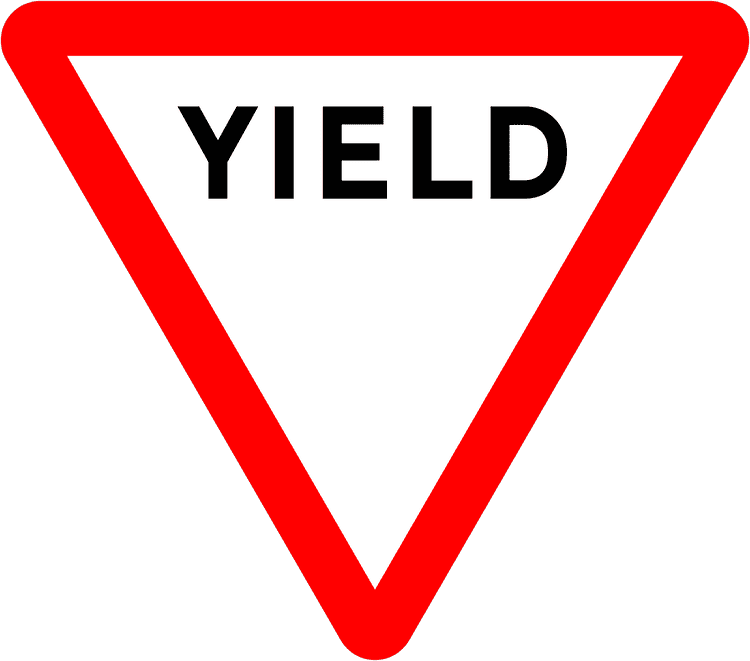
"Give way to traffic on the priority road."

  • Meaning:
  • 🔽 You must give way to traffic on the major road ahead.
  • 🚗 Let crossing traffic pass before you proceed.
  • Traffic Sign Examples

    YieldYield
    Mini Roundabout AheadMini Roundabout Ahead
  • 🛑 Be prepared to stop if necessary.
  • Where Found: Yield signs appear at T-junctions where minor roads join major routes throughout Ireland, at roundabout entrances where circulating traffic has priority, at merging lanes on dual carriageways and motorways, and at controlled junctions where yield rather than stop is appropriate. Common locations include estate roads joining distributor roads, slip roads entering national routes, junctions where sight lines allow safe yielding assessment, and roundabouts in urban and rural areas. More frequent than stop signs due to allowing traffic flow while maintaining safety priority.
  • What It Means & How to React: Drivers must slow down and prepare to stop if necessary to give way to traffic on the priority road. Unlike stop signs, complete stopping is only required if approaching traffic makes proceeding unsafe. Drivers must yield to all traffic from the right on roundabouts, oncoming traffic when turning right, and traffic on main roads when emerging from minor roads. Assessment of safe gaps is the driver's responsibility: proceed only when certain that adequate space exists without forcing priority traffic to slow or change course.
  • Penalties: Yield violations resulting in dangerous situations carry €80 fixed charge penalties and 3 penalty points under failure to yield regulations. Yield sign violations causing collisions often result in full civil liability and dangerous driving charges: fines to €5,000, 5 penalty points, potential license suspension. At roundabouts, yield violations frequently cause multi-vehicle collisions with serious insurance and legal consequences. Poor gap judgment at yield signs often indicates inadequate hazard perception skills, potentially requiring extended driving instruction before license restoration after violations.
  • Exam/Theory Info: Yield sign understanding is extensively tested in theory and practical examinations as proper yielding demonstrates hazard perception and gap judgment skills essential for safe driving. Theory questions test understanding that yield means 'give way if necessary,' that gap assessment is driver responsibility, and that yielding applies to roundabouts, T-junctions, and merging situations. Practical tests frequently assess yield compliance: examiners expect appropriate speed reduction when approaching yield signs, accurate assessment of approaching traffic, and safe proceeding only with adequate gaps. Good yielding technique shows mature driving judgment and awareness of priority rules.
  • How do you navigate a Mini Roundabout in Ireland?

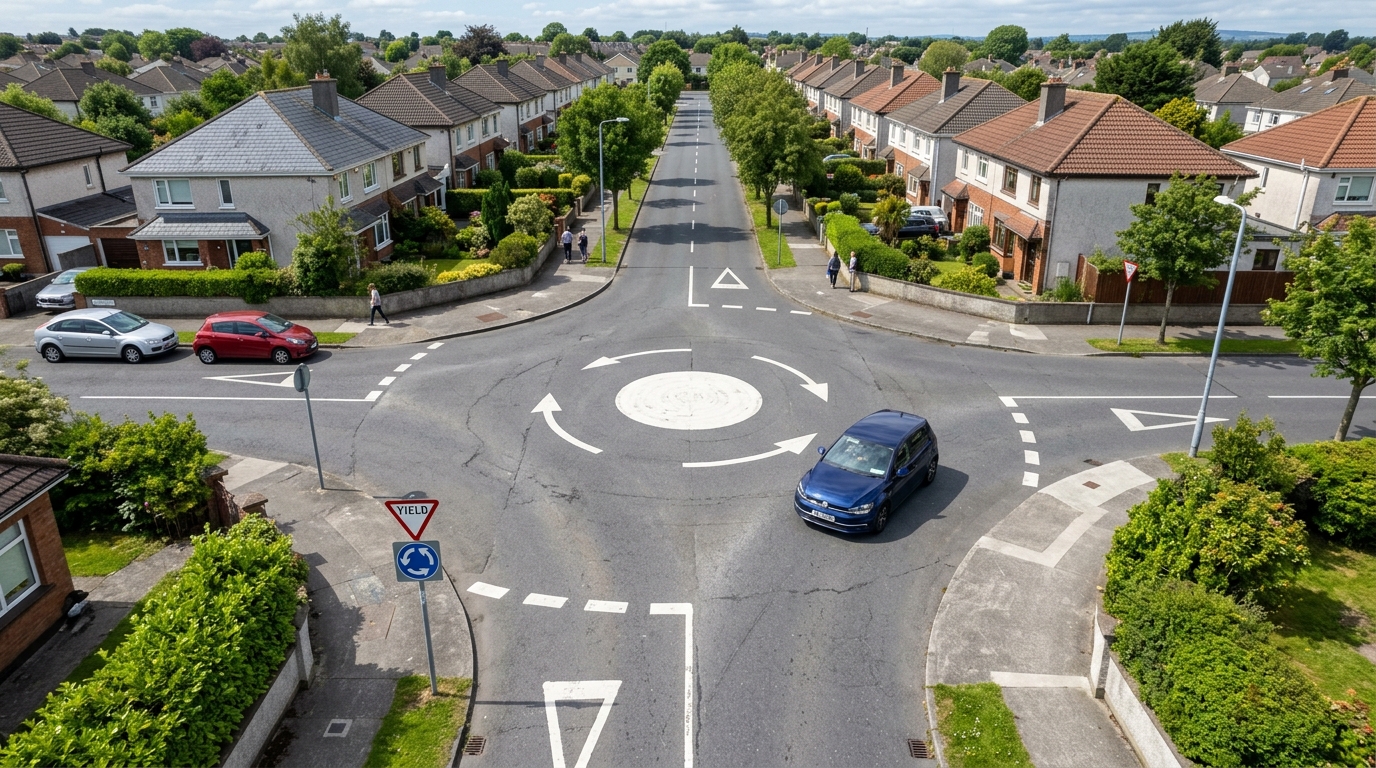
    "Small roundabout—tight geometry; right‑hand priority applies."

  • Meaning:
  • 🔄 Warns of a mini-roundabout ahead.
  • ➡️ Give way to traffic already on the roundabout (from your right).
  • 🐢 Slow down due to the tight turning circle.
  • Where Found: Mini roundabouts appear in residential areas, small town centers, and at junctions where full-size roundabouts cannot fit due to space constraints. Common in Dublin suburbs, throughout town centers in counties like Cork, Galway, and Limerick, and in village centers nationwide. Mini roundabouts typically have painted circles rather than raised centers, and their compact size requires different navigation techniques than standard roundabouts.
  • What It Means & How to React: A small roundabout with very tight turning geometry is ahead. Slow to 20-30 km/h before entering. The same priority rules apply as standard roundabouts: give way to traffic from your right already on the roundabout. Due to the tight turns, you cannot maintain normal speeds. Signal your exit as you would on larger roundabouts. Be aware that large vehicles may need to drive over the painted center circle due to their turning radius. Watch for cyclists who may struggle with the tight geometry. Approach with extra caution as visibility is often restricted at mini roundabouts.
  • Penalties: Failing to give way at mini roundabouts constitutes a junction violation: 2 penalty points and fines to €2,000. Entering at excessive speed that causes loss of control results in careless driving charges. If failure to yield causes a collision, dangerous driving charges apply: 5 penalty points, fines to €5,000, imprisonment, and disqualification. Many mini roundabout collisions occur because drivers treat them as standard junctions and fail to observe proper priority rules. Courts impose standard junction violation penalties.
  • Exam/Theory Info: Mini roundabouts are frequently included in practical driving tests as they assess multiple competencies simultaneously: observation, speed control, correct signaling, and priority application. Examiners expect approach speeds below 30 km/h, effective observation right and ahead, correct application of give-way rules, appropriate signaling of your intended exit, and smooth negotiation despite tight geometry. Entering too fast results in Grade 2 faults. Failing to give way to traffic from the right results in Grade 3 failure. The written component includes questions distinguishing mini roundabouts from standard roundabouts and the rules that apply to both.
  • What is the 12 O'Clock Rule for roundabout lane selection?

    For standard roundabouts, use the "12 o'clock rule" to determine which lane to choose:

  • Turning Left (Taking any exit before 12 o'clock): Signal left on approach. Position your vehicle in the left-hand lane. Maintain your left-signal until you exit.
  • Going Straight (Taking the exit at 12 o'clock): Do not signal on approach. Position your vehicle in the left-hand lane (unless markings indicate otherwise). Signal left only *after* passing the exit before the one you want.
  • Turning Right (Taking any exit after 12 o'clock): Signal right on approach. Position your vehicle in the right-hand lane. Maintain right-signal until you pass the exit before your destination, then switch to a left-signal and exit safely.
  • Frequently Asked Questions

    Who has right of way at roundabouts in Ireland?

    Vehicles already on the roundabout have the right of way. You must yield to all traffic approaching from your right before entering.

    Do I need to signal left when going straight (12 o'clock exit) at a roundabout?

    Yes. You do not signal on approach, but you must signal left immediately after you pass the exit prior to the one you intend to take.

    Can large vehicles drive over the center of mini roundabouts?

    Yes. Large commercial vehicles and buses are legally permitted to drive over the painted center circle if their turning circle prevents normal negotiation.

    Improve Your Driving Knowledge

    Download our app to test your understanding of traffic signs, or explore more articles on our blog.