Back to All Articles
Traffic Signs

The New Speed Limit Changes in Ireland: A Complete Guide

Traffic Safety Team

August 19, 2026
6 min read
The New Speed Limit Changes in Ireland: A Complete Guide

Featured Article

Speed management is one of the most critical aspects of road safety in Ireland. In recent years, the Road Safety Authority (RSA) and local councils have implemented sweeping speed limit changes to reduce collisions and save lives.

Understanding the posted speed limit signs—and knowing the default limits when no sign is visible—is a legal requirement for all drivers. This guide explains how speed limits work across the Irish road network.

Key Takeaways

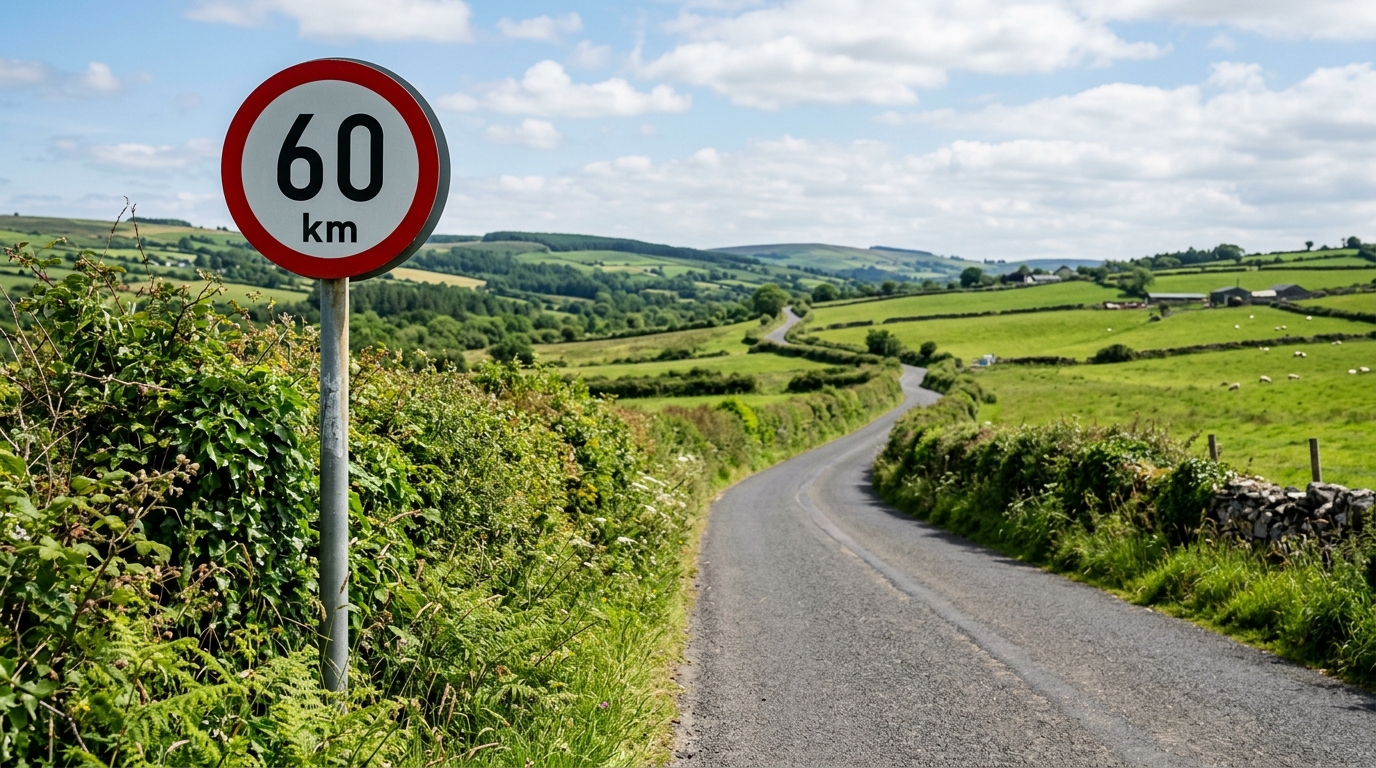
  • 🛑 Rural Road Reduction: Default limits on local rural single-carriageway roads (L roads) are reduced from 80 km/h to 60 km/h (RSA, 2026).
  • 🚗 Default Limits: 120 km/h on Motorways, 100 km/h on National Routes, 80 km/h on Regional Roads, and 50 km/h in Built-up Areas.
  • 📉 Safety Impact: Driving just 5% above the limit increases collision risk by 20% on undivided single lanes (RSA, 2025).

Here is the key speed limit sign you must understand:

What is the Rural Speed Limit in Ireland?

"Posted maximum rural road speed."

  • Meaning:
  • 🔚 The previous speed limit has ended.
  • 🚗 The national speed limit for this type of road now applies.
  • ℹ️ For cars, this is typically 80 km/h on rural roads.
  • Where Found: Rural Speed Limit signs appear at the end of urban speed limit zones and special speed limit areas throughout Ireland, marking transitions from lower speed limits (30, 40, 50 km/h) back to national speed limits. Common at the outskirts of towns and villages on National and Regional Roads where urban 50 km/h limits end and 80 km/h rural limits resume. Found leaving Dublin city limits on routes like N1, N2, N3, N4, N7, N8, N11, leaving Cork city on N8, N20, N22, N25, and leaving Galway city on N6, N17, N18, N84. The sign indicates the end of restricted speed zones.
  • What It Means & How to React: The special speed limit zone has ended and national speed limits now apply based on road type. For cars: 80 km/h on rural single carriageways, 100 km/h on dual carriageways, 120 km/h on motorways. For other vehicles different limits apply: trucks and buses typically 80 km/h maximum regardless of road type. The sign doesn't specify the exact limit—drivers must know applicable limits for their vehicle type and road classification. Novice drivers (within first two years) must not exceed 80 km/h even on motorways. The transition from urban to rural limits often occurs gradually rather than abruptly.
  • Penalties: Exceeding rural speed limits results in standard speeding penalties graduated by excess speed: 80-89 km/h in 80 zone (€80, 2 points), 90-99 km/h (€80, 4 points), 100+ km/h (€200, 5 points, court proceedings). GoSafe camera vans and fixed cameras extensively monitor rural roads particularly on routes with high collision rates. Excessive speeding on rural roads often results in dangerous driving charges due to collision risks: fines to €5,000, 5 penalty points, potential imprisonment, and disqualification. Rural roads have higher fatality rates making speed enforcement a priority. Court proceedings for serious rural speeding often result in disqualifications.
  • Exam/Theory Info: National speed limit knowledge is fundamental to theory test success. Questions extensively test speed limits for different vehicle types, road classifications, and driver categories (novice vs. full license holders). You must know that Rural Speed Limit signs end restricted zones but don't specify exact limits—you must know applicable limits for your vehicle and road type. Practical tests assess speed limit awareness: examiners expect appropriate speed adjustment when encountering Rural Speed Limit signs, recognition of road type determining applicable limits, and adherence to speed restrictions appropriate for vehicle type and driver category. Inappropriate speeds result in Grade 2 or Grade 3 faults.
  • What are the default speed limits in Ireland for 2026?

    If you do not see a speed limit sign, the default limits for cars are determined by the road classification:

  • Motorways (M Roads): 120 km/h
  • National Routes (N Roads - Dual Carriageways): 100 km/h
  • National Routes (N Roads - Single Carriageways): 100 km/h
  • Regional Roads (R Roads): 80 km/h
  • Local Rural Roads (L Roads): 60 km/h *(Reduced from 80 km/h under recent safety updates to protect road users on narrow country lanes).*
  • Built-Up Urban Areas: 50 km/h (often reduced to 30 km/h in residential zones or school environments).
  • Ireland Speed Limit Comparisons (km/h)

    Speed Limits in Ireland (km/h)Horizontal bar chart showing speed limit classifications: Motorways at 120, National routes at 100, Regional roads at 80, Local rural roads at 60, and Urban areas at 50. Source: RSA, 2026.Motorways (M)National Routes (N)Regional Roads (R)Local Rural (L)Urban AreasSpecial Zones120 km/h100 km/h80 km/h60 km/h50 km/h30 km/h030 km/h60 km/h90 km/h120 km/hSource: Road Safety Authority (RSA) Ireland (2026 Default Limits)

    Frequently Asked Questions

    What is the legal speed limit on single-lane local rural roads in Ireland?

    Following recent safety reviews, the default speed limit for local rural roads (L roads) has been reduced to 60 km/h to lower risks on narrow country lanes.

    What are GoSafe vans in Ireland?

    GoSafe vans are mobile speed detector vehicles operated on behalf of the Gardaí. They monitor designated speed enforcement zones where high collision rates exist.

    Is there a grace margin for speeding in Ireland?

    Legally, there is no official speed limit grace margin. Speed limits are absolute limits rather than targets, and violations are subject to fixed charge penalties of €80 and 3 penalty points.

    Improve Your Driving Knowledge

    Download our app to test your understanding of traffic signs, or explore more articles on our blog.