AI Summary
Key Takeaways
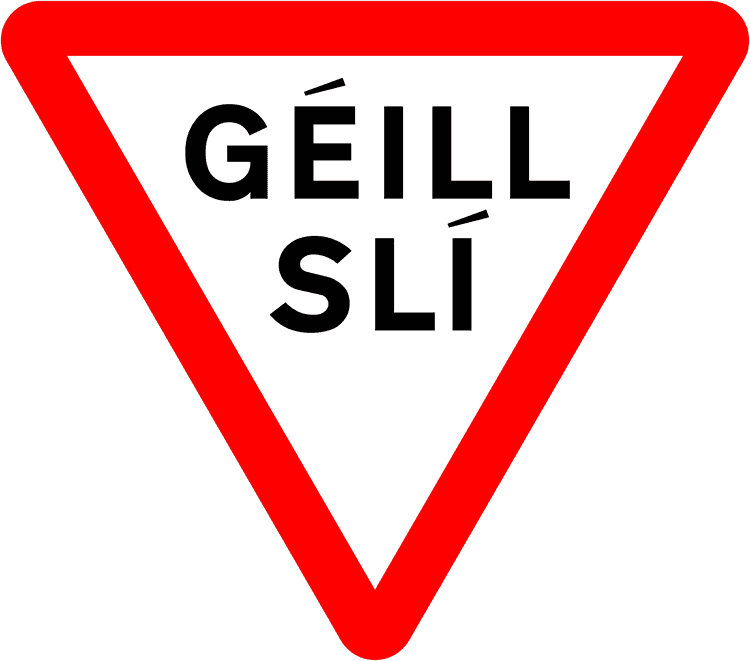
A compact, citation-friendly overview of Géill Slí (Yield sign in Irish).
- Meaning: 🔽 'Géill Slí' means 'Yield' or 'Give Way' in Irish.<br/>🚗 You must give way to traffic on the major road ahead.<br/>🛑 Be prepared to stop if necessary.
- Category: Regulatory Signs
- Action required: 'Géill Slí' (pronounced 'GAYL slee') translates directly as 'Yield Way' or 'Give Way,' functioning identically to English-language yield signs. The sign requires drivers to give priority to traffic on the intersecting road, stopping if necessary to allow priority traffic to pass. The Irish language doesn't change the regulatory meaning—drivers must slow significantly, assess priority road conditions, and proceed only when safe gaps exist, stopping completely if priority traffic approaches. The sign appears at junctions where visibility, traffic volumes, or accident history justify yield control rather than uncontrolled junctions. For non-Irish speakers, recognition of the triangular red-bordered sign shape indicates yield regardless of language—international sign shapes and colors convey meaning even when text differs. Visitors to Gaeltacht areas should familiarize themselves with basic Irish road sign vocabulary: 'Géill Slí' (Yield), 'Stop' (Stop—identical in Irish), 'Móill' (Slow), distances in kilometers remain numeric.
- Penalty note: Géill Slí violations carry identical penalties to English-language yield sign violations: fixed penalties (€80, 2 penalty points) for failing to yield, escalating to careless driving (€80-€120, 2-3 points) or dangerous driving (€5,000, 5 points, disqualification) if collisions result. 'Didn't understand Irish' defenses are ineffective—the triangular red-bordered sign shape is internationally recognized as yield/give way regardless of language, and drivers are responsible for understanding signs in areas they drive. Insurance liability assessments treat Irish-language sign violations identically to English-language violations—failing to yield at marked junctions typically establishes 70-90% liability against the emerging driver. Foreign visitors unfamiliar with Irish language face identical enforcement—signs' visual characteristics (shape, color, position) convey meaning. Tourist rental car companies often provide brief guides to Irish road sign vocabulary for visitors traveling to Gaeltacht areas. The Official Languages Act ensures signage equality, but doesn't alter underlying traffic law obligations.