Irish Traffic Signs Logo
Irish Traffic Signs
SignsBlogPenalty PointsAppFAQHelp CenterFavorites
Irish Traffic Signs

Learn Irish traffic signs with visual matching quizzes and detailed explanations. Free platform for drivers preparing for their test.

Learn

  • Traffic Signs
  • Interactive Quiz
  • Mobile App

Support

  • Help Center
  • FAQ
  • Penalty Points

Company

  • About Us
  • Privacy Policy
  • Terms of Service

© 2026 Irish Traffic Signs. All rights reserved.

This is not an official application. It is prepared for educational purposes.

Made with ❤️ for Irish drivers

HomeRegulatory SignsMini Roundabout
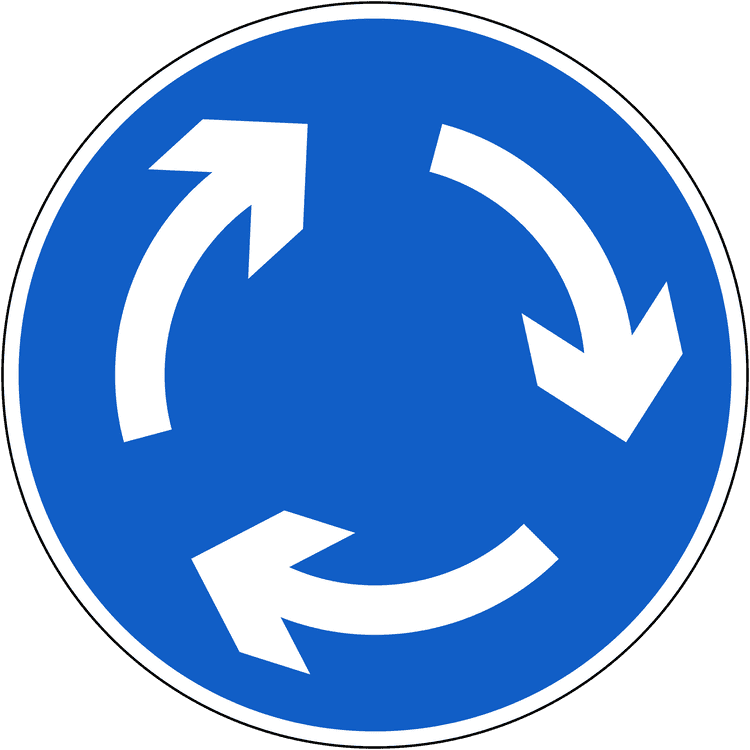
A regulatory road sign in Ireland enforcing mini roundabout. Essential for the Driving Theory Test.

Mini Roundabout

Category

Regulatory

Difficulty

Intermediate

What Does This Sign Mean?

Mini roundabout—priority to right circulating traffic.

Key Points:

🔄 You are at a mini-roundabout.
➡️ Give way to traffic from your right.
🚗 Drive over the painted circle if necessary, but only if it is safe.

Related Regulatory signs

  • A regulatory road sign in Ireland enforcing yield. Essential for the Driving Theory Test.

    Yield

  • A regulatory road sign in Ireland enforcing segregated route for pedal cycles and pedestrians (cycle on right). Essential for the Driving Theory Test.

    Segregated Route for Pedal Cycles and Pedestrians (Cycle on Right)

  • A regulatory road sign in Ireland enforcing prohibited axles in right hand lane. Essential for the Driving Theory Test.

    Prohibited Axles in Right Hand Lane

  • A regulatory road sign in Ireland enforcing pedestrian crossing. Essential for the Driving Theory Test.

    Pedestrian Crossing

  • A regulatory road sign in Ireland enforcing géill slí (yield sign in irish). Essential for the Driving Theory Test.

    Géill Slí (Yield sign in Irish)

  • A regulatory road sign in Ireland enforcing turn right. Essential for the Driving Theory Test.

    Turn Right

Complete Guide to This Sign

Where You'll Find This Sign

Mini roundabouts appear at junctions in urban and suburban areas throughout Ireland where space constraints prevent full-size roundabouts but junction control is needed.

Common in Dublin suburbs (Rathfarnham, Churchtown, Drumcondra residential areas), Cork suburbs, Galway city residential zones, and Limerick estate networks.

These compact roundabouts feature painted circular markings (typically 4-6 metres diameter) rather than raised central islands, often with blue circular mini-roundabout signs with white circular arrows approaching from each junction arm.

Residential estates use mini roundabouts extensively to control junctions while maintaining traffic flow—cheaper and less space-consuming than signal-controlled junctions.

Some locations use slightly raised domes (10-15cm height) for the central circle providing visual and tactile feedback without completely preventing overriding.

The compact nature means all junction arms are typically single-lane approaches.

Urban traffic calming schemes frequently incorporate mini roundabouts to reduce speeds at junctions previously controlled only by yield signs or uncontrolled.

What This Means for Drivers

Mini roundabouts function identically to standard roundabouts regarding priority rules—traffic already circulating on the roundabout (approaching from your right in left-side driving) has priority, and you must yield until a safe gap exists.

The key difference: the central circle is deliberately designed to be overridden by large vehicles that cannot navigate the tight turning radius.

Cars should circulate around the circle, but trucks, buses, and vehicles with trailers may drive over the painted circle if necessary for physical clearance—this is legal and expected.

However, all vehicles must still observe right-of-way rules—overriding the circle doesn't exempt you from yielding to traffic with priority.

Approach speeds should be low (15-20km/h) given tight geometry.

The compact design means less deflection than standard roundabouts, creating temptation to treat them as uncontrolled junctions—you must still yield to traffic from the right regardless of apparent sight lines or small gaps suggesting you could proceed.

Penalties & Legal Consequences

Mini roundabout violations typically involve failure to yield to traffic with priority, resulting in fixed penalties (€80, 2 penalty points) as baseline.

Collisions at mini roundabouts where drivers failed to yield properly result in primary liability (70-90%) against the failing driver.

The compact nature and good visibility at most mini roundabouts means 'didn't see' defenses are rarely accepted—all junction arms are usually visible from approach points.

Some drivers incorrectly believe mini roundabouts are advisory rather than mandatory junction control, treating them as uncontrolled junctions—this establishes negligence in collision scenarios.

Insurance companies scrutinize mini roundabout collisions for yield compliance—violations establish clear fault.

Excessive speed approaching mini roundabouts (not reducing appropriately for junction control) can escalate charges to dangerous driving (€5,000, 5 penalty points, disqualification) if collisions result, particularly in residential areas where pedestrian risks compound vehicular hazards.

Overriding the central circle is legal when necessary, so no penalties apply for that specific action unless done at excessive speed endangering others.

Appears in Driving Test?

Theory test questions about mini roundabouts emphasize understanding that they function identically to standard roundabouts regarding priority (yield to traffic from right), recognition that overriding the central circle is permitted when necessary for vehicle size, and appropriate approach speeds.

Questions assess understanding of when it's necessary versus merely convenient to override the circle, and why mini roundabouts exist rather than standard roundabouts or other junction controls.

Scenario questions test whether candidates recognize that mini roundabout priority rules apply regardless of junction size.

Practical driving tests always include mini roundabouts in areas where they exist; examiners assess: early recognition of mini roundabout signs and markings, appropriate speed reduction on approach (typically 15-20km/h), effective observation assessing traffic from all junction arms particularly traffic approaching from right, correct application of priority rules (yielding to traffic from right, proceeding when safe gaps exist), appropriate positioning (circulating around circle in standard cars, overriding only when necessary in larger vehicles), and smooth execution without excessive hesitation when clear gaps exist.

Common faults include: failing to recognize mini roundabouts treating them as uncontrolled junctions, failing to yield to traffic from right, excessive speed on approach, or unnecessary overriding of central circle.

Frequently Asked Questions about the Mini Roundabout Sign

What does the Mini Roundabout sign mean in Ireland?

In Ireland, the Mini Roundabout sign indicates: Mini roundabout—priority to right circulating traffic. Understanding this is crucial for safe driving and passing your DTT.

What type of sign is the Mini Roundabout?

The "Mini Roundabout" is officially classified as part of the REGULATORY group in Ireland. Like other signs of this type, it alerts drivers to specific rules, hazards, or information they must immediately observe.

Will the Mini Roundabout sign appear on the Irish Theory Test?

Yes, you should expect the Mini Roundabout sign to appear on your Irish Driving Theory Test (DTT). You must be able to identify it as a REGULATORY and know what it requires from you as a driver.

●Live App Updates

Master Irish Signs on Mobile

Get instant access to 400+ signs, interactive quizzes, and progress tracking. Download the free app today!

🍎
Download on
App Store
🤖
Get it on
Google Play