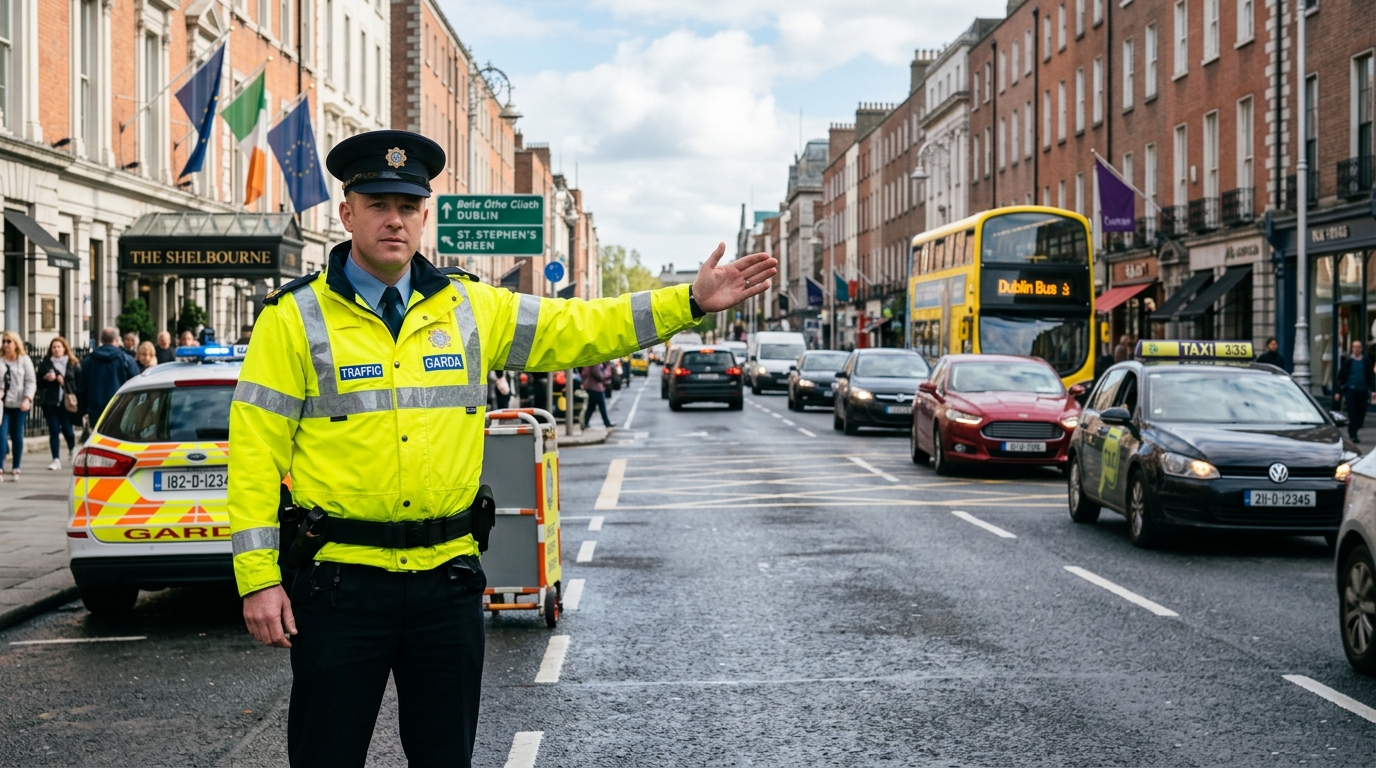
Have you ever approached a busy junction with broken traffic lights, only to find a member of An Garda Síochána standing in the middle of the road directing traffic? While it is not a daily occurrence, understanding police signals is essential.
Under Irish law, a Garda's hand signals take priority over all other signs, traffic lights, and road markings. Disobeying a Garda's direction is a road traffic offence that can lead to penalty points, court-ordered fines, and immediate failure on your practical driving test.
Key Takeaways
- •Legal Precedence: Garda hand signals legally override green traffic lights and stop signs.
- •Stop Signal (Oncoming): Raised hand, palm forward, stops all traffic coming from the front.
- •Stop Signal (Behind): Hand extended horizontally stops all traffic coming from behind.
- •Driving Test Impact: Failing to obey a Garda during a driving test is a Grade 3 fault (immediate fail).
The Legal Status of Garda Hand Signals
The authority of a police officer directing traffic is established in Section 109 of the Road Traffic Act 1961. Under this legislation, you must stop your vehicle when directed by a member of the Gardaí.
If a junction has a green traffic light but a Garda signals you to stop, you must obey the Garda. Moving past the officer constitutes an offence under the Act, leading to a fixed charge fine of €80 and up to 3 penalty points.
Road Traffic Act Citation Capsule
Under Section 109 of the Road Traffic Act 1961, any driver who fails to stop when directed by a member of An Garda Síochána commits a summary offence. The police officer's hand directions override all automated lights and priority markings.
The 4 Key Garda Hand Signals Explained
Here is a guide to the four mandatory hand signals you must know:
Stop Traffic from the Front
The officer will raise their arm vertically with their palm facing forward. If you are approaching from the front, you must stop.
Stop Traffic from Behind
The officer will extend their arm horizontally to the side, palm facing backwards. If you are approaching from behind, you must stop before the junction.
Stop Traffic from Front and Behind
The officer will raise one arm vertically (for oncoming traffic) and extend the other arm horizontally (for traffic behind). All traffic must stop.
Keep Traffic Moving
The officer will look towards your lane and wave their hand or arm forward in a beckoning motion, signaling that it is safe to proceed.
What to Do in Your Driving Test
If a Garda is directing traffic on your route during your practical driving test, stay calm. Make sure you approach the junction slowly and look closely at the officer.
Do not move forward until the Garda gives you a clear beckoning signal. If you proceed when they have signaled stop, it is classified as a Grade 3 dangerous fault, resulting in immediate failure.
Frequently Asked Questions
Do Garda hand signals override green traffic lights?
Yes. Under Irish law, directions given by a member of An Garda Síochána override green traffic lights, yield signs, and stop lines.
Do school wardens have authority to stop traffic?
Yes, school wardens displaying an official STOP sign have legal authority to halt traffic for crossing children. Disobeying them is a punishable offence.
How do Gardaí direct traffic at night?
At night or in low visibility, Gardaí use illuminated red/green wands or high-intensity torches. The same standard arm gestures apply.
What penalty applies if I ignore a Garda signal?
Failing to stop when directed by a Garda carries an immediate €80 fixed fine and up to 3 penalty points. On a driving test, it causes an automatic Grade 3 fail.
Conclusion
Garda hand signals are simple to read once you understand the basic arm and hand positions. By keeping your speed low, observing the officer's gestures, and understanding that their authority overrides automated lights, you will stay safe and pass your driving test.