AI Summary
Key Takeaways
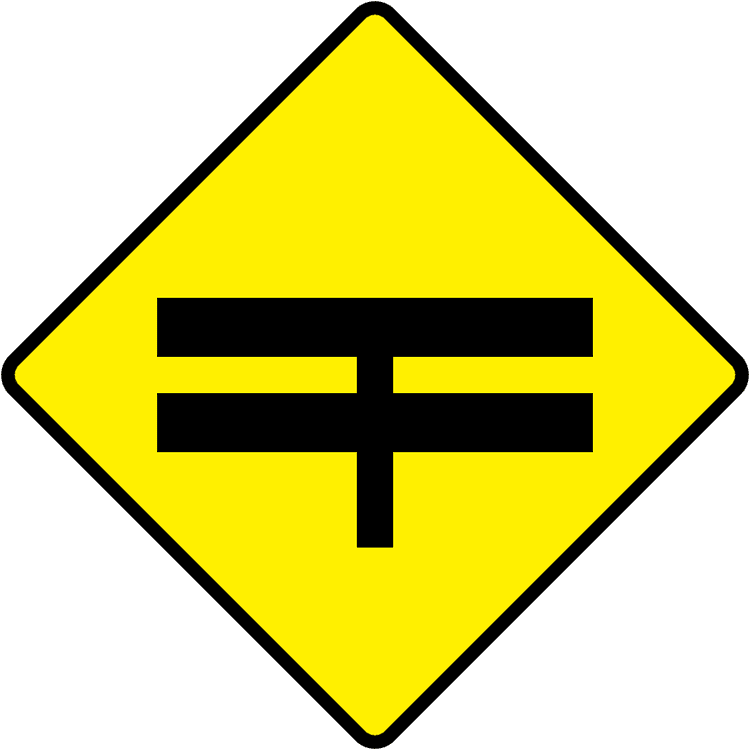
A compact, citation-friendly overview of T Junction Ahead at Dual C'way (With CR Break).
- Meaning: 🛣️ The road ahead joins a dual carriageway at a T-junction.<br/>↔️ There is a gap in the central reserve.<br/>🚗 This allows you to turn right, but be extremely careful of fast-moving traffic.
- Category: Warning Signs
- Action required: This sign warns of approaching T-junction at a dual carriageway where the central reservation has a break (opening), allowing you to turn either left or right. The critical difference from no-break junctions: right turns are possible but extremely hazardous due to crossing opposing carriageway traffic traveling at 100-120km/h. Right-turning vehicles must cross the nearside carriageway, enter the central reservation gap, wait for suitable gaps in far carriageway traffic, then complete the turn—requiring judgment of vehicles approaching at motorway speeds from considerable distances. Most such junctions provide protected right-turn lanes with YIELD or STOP control. The sign indicates need for early lane selection, significant speed reduction from approach speeds, and extended observation periods. Left turns are comparatively simpler, requiring only merging with nearside traffic, though speeds remain high.
- Penalty note: Poor judgment at dual carriageway T-junctions with central reservation breaks frequently causes severe collisions with serious legal consequences. Entering dual carriageways without yielding to priority traffic constitutes careless driving at minimum (€80-€120, 2-3 penalty points), escalating rapidly to dangerous driving charges (€5,000, 5 penalty points, disqualification) when collisions occur. Given opposing traffic speeds of 100km/h+, collisions at such junctions often involve serious injuries or fatalities, triggering vehicular manslaughter investigations under Section 4 of the Road Traffic Act 2010 (prison sentences up to 10 years). Insurance liability assessments typically assign 80-100% fault to vehicles emerging from minor roads that misjudged gaps. The advance warning establishes that drivers had notice to prepare for complex high-speed junction maneuvers, making 'didn't see' defenses ineffective.