Irish Traffic Signs Logo
Irish Traffic Signs
SignsBlogPenalty PointsAppFAQHelp CenterFavorites
TikTokInstagramFacebookThreadsX
Irish Traffic Signs

Learn Irish traffic signs with visual matching quizzes and detailed explanations. Free platform for drivers preparing for their test.

TikTokInstagramFacebookThreadsX

Learn

  • Traffic Signs
  • Signs & Meanings
  • Mobile App

Support

  • Help Center
  • FAQ
  • Penalty Points

Company

  • About Us
  • Privacy Policy
  • Terms of Service

© 2026 Irish Traffic Signs. All rights reserved.

This is not an official application. It is prepared for educational purposes.

Made with ❤️ for Irish drivers

HomeWarning SignsT Junction (Major Road) Ahead
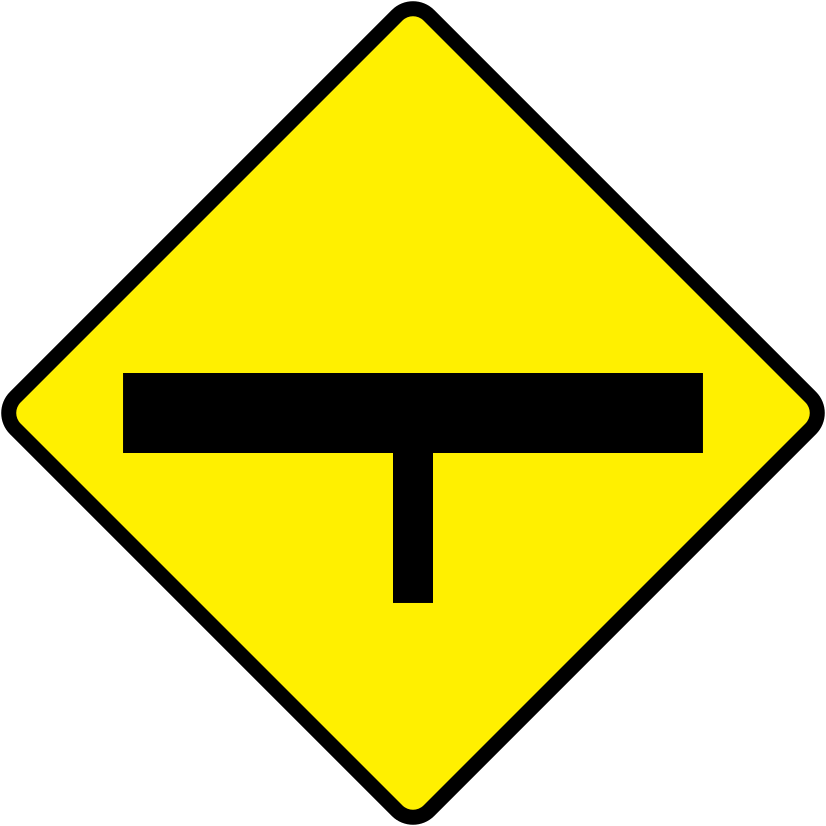
A triangular warning traffic sign in Ireland depicting t junction (major road) ahead. Memorize for DTT.

T Junction (Major Road) Ahead

AI Summary

Key Takeaways

A compact, citation-friendly overview of T Junction (Major Road) Ahead.

GEO-ready
  • Meaning: ⊥ T-junction ahead where you must give way.<br/>🚗 Traffic on the major road has priority.<br/>🛑 Be prepared to stop before joining the main road.
  • Category: Warning Signs
  • Action required: This sign warns of approaching T-junction termination at a major road where you will not have priority—you must yield or stop (depending on junction control) to allow main road traffic to pass. The T-configuration means you can turn left or right but cannot continue straight—your road ends. The warning emphasizes that the cross-road is a major priority route with higher traffic volumes and speeds, requiring particular caution. Drivers should reduce speed upon seeing this warning, assess which direction they'll turn, and prepare for potentially long waits if main road traffic is heavy. The major road designation indicates traffic flows at or near speed limits (often 80-100km/h), making gap judgment critical. Some T-junctions have STOP sign control (mandatory halt), others have YIELD signs (stop only if necessary). The advance warning allows time to position correctly, check mirrors, signal intentions, and prepare for the turning maneuver.
  • Penalty note: The advance warning sign itself carries no penalty, but failing to yield or stop appropriately at T-junctions with major roads frequently results in serious collisions and charges. Emerging from minor roads without yielding properly constitutes careless driving at minimum (€80-€120, 2-3 penalty points), escalating to dangerous driving (€5,000, 5 penalty points, disqualification) if collisions occur, especially those involving high-speed main road traffic. 'Failed to yield' collisions at T-junctions typically establish primary liability (80-100%) against the emerging driver. Insurance companies examine whether drivers from minor roads took adequate precautions—the advance warning establishes drivers had notice to prepare. Fatal accidents at such junctions can result in vehicular manslaughter charges under Section 4 of the Road Traffic Act 2010, carrying prison sentences up to 10 years. The RSA identifies T-junctions as high-risk locations accounting for significant collision percentages.

Reference Table

Core Sign Facts

Structured metadata for quick AI parsing and theory-test recall.

Core facts about T Junction (Major Road) Ahead
Sign nameT Junction (Major Road) Ahead
Sign typeWarning Signs
Expected in DTT?Yes. This sign is commonly covered in Irish driving theory test preparation.
Action requiredThis sign warns of approaching T-junction termination at a major road where you will not have priority—you must yield or stop (depending on junction control) to allow main road traffic to pass. The T-configuration means you can turn left or right but cannot continue straight—your road ends. The warning emphasizes that the cross-road is a major priority route with higher traffic volumes and speeds, requiring particular caution. Drivers should reduce speed upon seeing this warning, assess which direction they'll turn, and prepare for potentially long waits if main road traffic is heavy. The major road designation indicates traffic flows at or near speed limits (often 80-100km/h), making gap judgment critical. Some T-junctions have STOP sign control (mandatory halt), others have YIELD signs (stop only if necessary). The advance warning allows time to position correctly, check mirrors, signal intentions, and prepare for the turning maneuver.
AppearanceTriangular / Red and white
Typical locationThis warning appears where minor roads terminate at major priority routes, particularly common throughout rural Ireland where local roads (L-class), regional roads (R-class), or minor N-roads meet busy N-roads or major regional routes. Typical locations include agricultural areas in Cork, Tipperary, Limerick, and Galway where farm access roads and village connectors join primary routes. You'll encounter these on approaches to N7, N8, N20, N24, and other busy N-roads where traffic volumes and speeds create significant hazards for vehicles emerging from minor roads. Sign placement occurs 100-200 metres before the T-junction, often accompanied by YIELD or STOP signs at the junction itself. These warnings are particularly important where approach curves, hedgerows, or terrain prevent early junction visibility, or where recent traffic speed increases on main roads made advance warnings necessary.

This page explains what the T Junction (Major Road) Ahead sign means, where it is typically found, and how drivers should respond in Ireland. It also connects you to closely related signs so you can compare similar road situations and build stronger theory-test recall.

What Does This Sign Mean?

T‑junction meets major priority road.

Key Points:

⊥ T-junction ahead where you must give way.
🚗 Traffic on the major road has priority.
🛑 Be prepared to stop before joining the main road.

Related Warning signs

  • A triangular warning traffic sign in Ireland depicting t-junction (type 1) - right. Memorize for DTT.

    T-Junction (Type 1) - Right

  • A triangular warning traffic sign in Ireland depicting t-junction (type 1) - left. Memorize for DTT.

    T-Junction (Type 1) - Left

  • A triangular warning traffic sign in Ireland depicting t junction ahead at dual c'way (no cr break). Memorize for DTT.

    T Junction Ahead at Dual C'way (No CR Break)

  • A triangular warning traffic sign in Ireland depicting junction with major road at sharp corner - left. Memorize for DTT.

    Junction With Major Road at Sharp Corner - Left

  • A triangular warning traffic sign in Ireland depicting t-junction (type 2) - right. Memorize for DTT.

    T-Junction (Type 2) - Right

  • A triangular warning traffic sign in Ireland depicting t-junction (type 2) - left. Memorize for DTT.

    T-Junction (Type 2) - Left

More Warning Signs Signs

Accompanied Horses
Accompanied Horses warning sign in Ireland. This traffic sign alerts drivers that horses (ridden or led) may be on or crossing the road ahead. Horses can react unpredictably to traffic, requiring drivers to reduce speed and give them ample space.
Barrier Board - 3 Bars
Start of a taper—lane/shoulder begins narrowing ahead.
Barrier Board - 4 Bars
Mid‑taper—remaining merging distance is reduced.
Barrier Board - 5 Bars
Taper end—closure point is imminent or lane fully ending.
Cattle or Farm Animals
Farm animals may be walking, crossing, or standing on the carriageway.
Children Crossing
High likelihood of children crossing (school/play area proximity).

Complete Guide to This Sign

Where You'll Find This Sign

This warning appears where minor roads terminate at major priority routes, particularly common throughout rural Ireland where local roads (L-class), regional roads (R-class), or minor N-roads meet busy N-roads or major regional routes.

Typical locations include agricultural areas in Cork, Tipperary, Limerick, and Galway where farm access roads and village connectors join primary routes.

You'll encounter these on approaches to N7, N8, N20, N24, and other busy N-roads where traffic volumes and speeds create significant hazards for vehicles emerging from minor roads.

Sign placement occurs 100-200 metres before the T-junction, often accompanied by YIELD or STOP signs at the junction itself.

These warnings are particularly important where approach curves, hedgerows, or terrain prevent early junction visibility, or where recent traffic speed increases on main roads made advance warnings necessary.

What This Means for Drivers

This sign warns of approaching T-junction termination at a major road where you will not have priority—you must yield or stop (depending on junction control) to allow main road traffic to pass.

The T-configuration means you can turn left or right but cannot continue straight—your road ends.

The warning emphasizes that the cross-road is a major priority route with higher traffic volumes and speeds, requiring particular caution.

Drivers should reduce speed upon seeing this warning, assess which direction they'll turn, and prepare for potentially long waits if main road traffic is heavy.

The major road designation indicates traffic flows at or near speed limits (often 80-100km/h), making gap judgment critical.

Some T-junctions have STOP sign control (mandatory halt), others have YIELD signs (stop only if necessary).

The advance warning allows time to position correctly, check mirrors, signal intentions, and prepare for the turning maneuver.

Penalties & Legal Consequences

The advance warning sign itself carries no penalty, but failing to yield or stop appropriately at T-junctions with major roads frequently results in serious collisions and charges.

Emerging from minor roads without yielding properly constitutes careless driving at minimum (€80-€120, 2-3 penalty points), escalating to dangerous driving (€5,000, 5 penalty points, disqualification) if collisions occur, especially those involving high-speed main road traffic. 'Failed to yield' collisions at T-junctions typically establish primary liability (80-100%) against the emerging driver.

Insurance companies examine whether drivers from minor roads took adequate precautions—the advance warning establishes drivers had notice to prepare.

Fatal accidents at such junctions can result in vehicular manslaughter charges under Section 4 of the Road Traffic Act 2010, carrying prison sentences up to 10 years.

The RSA identifies T-junctions as high-risk locations accounting for significant collision percentages.

Appears in Driving Test?

Theory test questions about T-junctions at major roads emphasize priority rules, appropriate responses to warnings, and safe gap judgment.

Questions assess understanding of what this sign means, who has priority, and what preparations you should make when seeing it.

Scenario questions might test understanding of differences between YIELD vs STOP control at such junctions.

Practical driving tests always include junctions where minor roads meet major roads; examiners assess appropriate responses to advance warnings: early speed reduction, correct lane positioning for intended turn, timely signaling, effective observation assessing main road traffic speeds and gaps, and safe junction execution.

Common faults include inadequate observation (underestimating main road traffic speeds), poor gap judgment (pulling out when insufficient space exists), or approaching junctions too fast indicating failure to respond to advance warnings.

Frequently Asked Questions about the T Junction (Major Road) Ahead Sign

What does the T Junction (Major Road) Ahead sign mean in Ireland?

In Ireland, the T Junction (Major Road) Ahead sign indicates: T‑junction meets major priority road. Understanding this is crucial for safe driving and passing your DTT.

What type of sign is the T Junction (Major Road) Ahead?

The "T Junction (Major Road) Ahead" is officially classified as part of the WARNING group in Ireland. Like other signs of this type, it alerts drivers to specific rules, hazards, or information they must immediately observe.

Will the T Junction (Major Road) Ahead sign appear on the Irish Theory Test?

Yes, you should expect the T Junction (Major Road) Ahead sign to appear on your Irish Driving Theory Test (DTT). You must be able to identify it as a WARNING and know what it requires from you as a driver.

●Live App Updates

Master Irish Signs on Mobile

Get instant access to 400+ signs, interactive quizzes, and progress tracking. Download the free app today!

🍎
Download on
App Store
🤖
Get it on
Google Play