Irish Traffic Signs Logo
Irish Traffic Signs
SignsBlogPenalty PointsAppFAQHelp CenterFavorites
Irish Traffic Signs

Learn Irish traffic signs with visual matching quizzes and detailed explanations. Free platform for drivers preparing for their test.

Learn

  • Traffic Signs
  • Interactive Quiz
  • Mobile App

Support

  • Help Center
  • FAQ
  • Penalty Points

Company

  • About Us
  • Privacy Policy
  • Terms of Service

© 2026 Irish Traffic Signs. All rights reserved.

This is not an official application. It is prepared for educational purposes.

Made with ❤️ for Irish drivers

HomeRegulatory SignsMaximum Vehicle Length
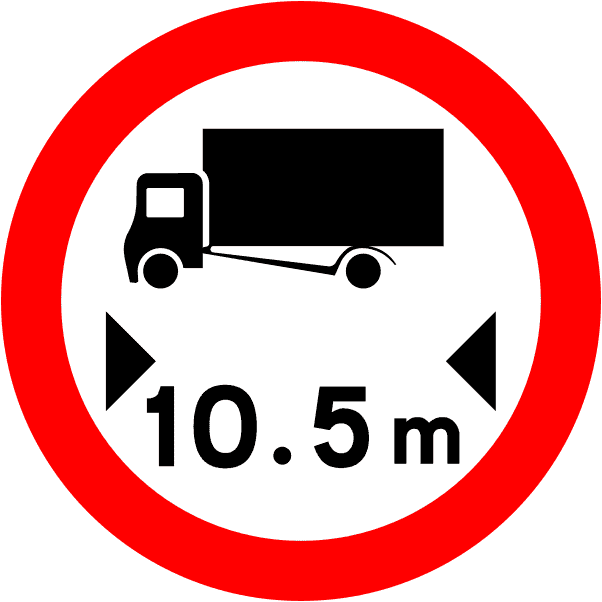
A regulatory road sign in Ireland enforcing maximum vehicle length. Essential for the Driving Theory Test.

Maximum Vehicle Length

Category

Regulatory

Difficulty

Intermediate

What Does This Sign Mean?

Length limit due to geometry constraints.

Key Points:

⛔ Vehicles longer than the length shown are prohibited.
🔄 This is usually due to tight turns or narrow spaces ahead.
🚚 Drivers of long vehicles must find an alternative route.

Related Regulatory signs

  • A regulatory road sign in Ireland enforcing rural speed limit. Essential for the Driving Theory Test.

    Rural Speed Limit

  • A regulatory road sign in Ireland enforcing maximum vehicle width. Essential for the Driving Theory Test.

    Maximum Vehicle Width

  • A regulatory road sign in Ireland enforcing maximum axle weight. Essential for the Driving Theory Test.

    Maximum Axle Weight

  • A regulatory road sign in Ireland enforcing lrt speed limit. Essential for the Driving Theory Test.

    LRT Speed Limit

  • A regulatory road sign in Ireland enforcing height restriction. Essential for the Driving Theory Test.

    Height Restriction

  • A regulatory road sign in Ireland enforcing speed limit 60 km. Essential for the Driving Theory Test.

    Speed Limit 60 km

Complete Guide to This Sign

Where You'll Find This Sign

Maximum Vehicle Length restrictions appear on routes where geometric constraints prevent long vehicles from navigating safely, common throughout heritage town centers, coastal villages, and mountainous areas.

Typical locations include narrow streets in medieval town centers (Kilkenny city center, Galway Latin Quarter, Kinsale historic core), coastal villages with tight harbor-side streets (Roundstone in Connemara, Dingle town, Baltimore in West Cork), and mountain passes with hairpin bends (Healy Pass, Conor Pass, Gap of Dunloe).

Common restrictions range from 8-12 metres depending on turning radii and road widths.

Signs are positioned 200-500 metres before the restricted section, often supplemented by advance directional signs routing long vehicles to alternative routes.

Tourist coach routes carefully avoid these restrictions, but occasional navigation errors result in coaches becoming stuck in narrow streets requiring complex reversing maneuvers or even building damage.

What This Means for Drivers

This sign prohibits vehicles exceeding the displayed length from proceeding, implemented because geometric constraints ahead prevent long vehicles from maneuvering safely.

Vehicle length is measured from front bumper to rear (including tow bars, but excluding loads overhanging beyond vehicle structure).

The restriction addresses turning radius limitations—long vehicles cannot navigate tight corners, hairpin bends, or reversing requirements in constrained spaces.

Common scenarios requiring length restrictions: medieval streets with 90-degree corners at building faces, coastal villages with tight harbor turns, mountain passes with switchback hairpin bends requiring multiple-point turns for long vehicles, and narrow bridges with limited approach angles.

Drivers of long vehicles (coaches, articulated trucks, vehicles with trailers, large motorhomes) must verify their vehicle length against restriction limits and plan routes using unrestricted alternatives.

Some restrictions are seasonal (tourist season only) balancing local access needs against summer tourist coach traffic.

Penalties & Legal Consequences

Length restriction violations result in fixed penalties (€80, 2 penalty points) as baseline, but practical consequences often exceed regulatory penalties.

Vehicles exceeding length limits frequently become stuck requiring expensive recovery operations (€500-€2,000 crane/specialist recovery), traffic disruption (potentially hours while vehicles are extracted), and property damage (scraping buildings, damaging walls, breaking gates) with full repair costs billed to vehicle owners/operators.

Commercial coach operators face particular scrutiny—stuck coaches in heritage towns damage tourism reputations, resulting in operator license reviews and potential route prohibition orders.

Insurance companies may deny coverage for damage occurring during clear restriction violations—length breaches typically void policies.

Local authorities in tourist areas with frequent length restriction violations sometimes install physical barriers preventing entry by overlong vehicles.

Serious violations causing significant property damage or traffic disruption can escalate to dangerous driving charges (€5,000, 5 penalty points, disqualification).

Appears in Driving Test?

Theory test questions about length restrictions assess understanding of why geometric constraints necessitate limits, recognition of vehicle types affected (coaches, articulated trucks, vehicles with trailers), and consequences of violations.

Questions might ask what maximum length signs indicate, why restrictions exist, or appropriate responses when encountering unexpected length restrictions.

Coach and truck theory tests include detailed questions about measuring vehicle length, understanding turning radius requirements, route planning avoiding length restrictions, and identifying geometric hazards.

Practical car tests don't assess length restrictions directly (standard test vehicles well below typical limits), but candidates may encounter such signs and should demonstrate recognition.

HGV and coach practical tests in areas with length restrictions assess route planning knowledge, vehicle dimension awareness, and understanding of when length restrictions apply to test vehicles.

Common misconceptions include believing length restrictions don't apply to commercial vehicles with delivery purposes—restrictions typically have no exemptions given physical constraints.

Frequently Asked Questions about the Maximum Vehicle Length Sign

What does the Maximum Vehicle Length sign mean in Ireland?

In Ireland, the Maximum Vehicle Length sign indicates: Length limit due to geometry constraints. Understanding this is crucial for safe driving and passing your DTT.

What type of sign is the Maximum Vehicle Length?

The "Maximum Vehicle Length" is officially classified as part of the REGULATORY group in Ireland. Like other signs of this type, it alerts drivers to specific rules, hazards, or information they must immediately observe.

Will the Maximum Vehicle Length sign appear on the Irish Theory Test?

Yes, you should expect the Maximum Vehicle Length sign to appear on your Irish Driving Theory Test (DTT). You must be able to identify it as a REGULATORY and know what it requires from you as a driver.

●Live App Updates

Master Irish Signs on Mobile

Get instant access to 400+ signs, interactive quizzes, and progress tracking. Download the free app today!

🍎
Download on
App Store
🤖
Get it on
Google Play